5:47 AM, Latitude 71° North: One Scientist's Day Powered by Orbit
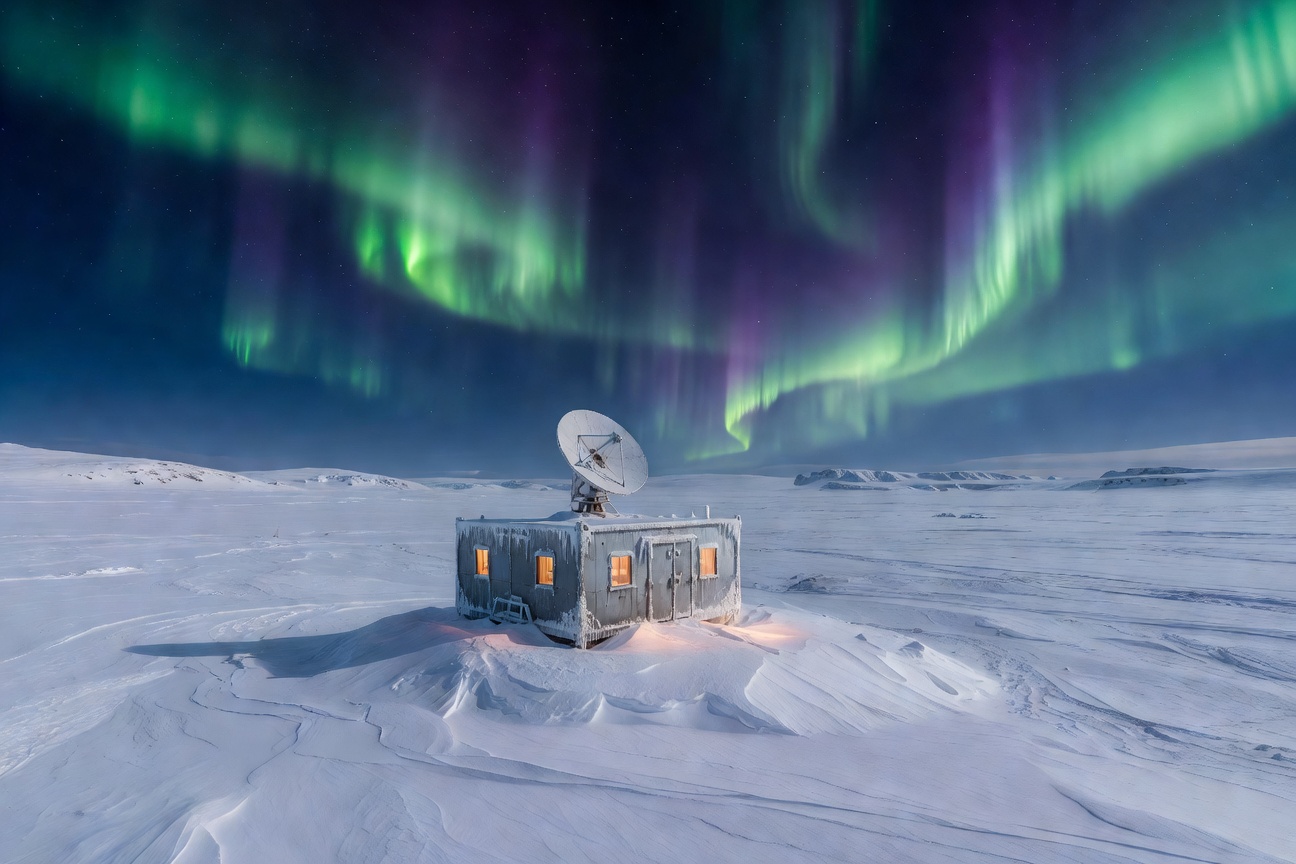
The alarm sounds at 5:47 AM inside a prefabricated module on the Svalbard archipelago, roughly 1,300 kilometers from the North Pole, where the temperature outside is minus twenty-two degrees Celsius and the polar night has not yet loosened its grip. Dr. Mara Lindqvist, a glaciologist with the Norwegian Polar Institute, does not reach first for her boots or her thermal layer. She reaches for her laptop. Within eight seconds, she has a 187-millisecond ping to a server in Oslo, a upload queue syncing overnight ice-core spectroscopy data to a university cluster in Tromsø, and a Slack notification from a colleague in Auckland who has already reviewed her preliminary findings. This is not a miracle. It is Tuesday.
The Geometry of Always-On
What makes Lindqvist's morning routine remarkable is not the hardware sitting on the station's roof, a white rectangular terminal roughly the size of a pizza box. What is remarkable is the invisible architecture above it: a mesh of low-Earth-orbit satellites circling at altitudes between 340 and 560 kilometers, close enough to Earth that signals travel at near-theoretical minimum latency, far enough to deliver coverage from pole to pole. SpaceX's Starlink constellation now exceeds 6,700 operational satellites, making it the largest active satellite network in human history. Amazon's Project Kuiper continues its deployment cadence following successful initial launches, while OneWeb, now operating under the Eutelsat umbrella, maintains coverage specifically optimized for polar and sub-polar latitudes. For Lindqvist, these are not headlines. They are the plumbing.
She opens a terminal window and runs a download of atmospheric pressure model data from the European Centre for Medium-Range Weather Forecasts. The 2.3-gigabyte file arrives in under four minutes. Eighteen months ago, the same transfer required scheduling overnight and hoping the facility's geostationary link did not degrade. "The geostationary dishes were pointed at a dot 36,000 kilometers away," she explains over a voice call that she takes while pulling on her outer layer. "The signal had to travel 72,000 kilometers round-trip just to say hello. You could feel the delay in every conversation. You planned your day around the lag."
When Bandwidth Becomes Infrastructure
By 7:15 AM, Lindqvist is outside in the darkness, checking sensor arrays embedded in the glacier's surface. She carries a ruggedized tablet connected to the same terminal via local Wi-Fi, streaming live telemetry from forty-two ground-penetrating radar nodes. The data does not queue for later. It goes up. A machine-learning model maintained by a research partner at ETH Zurich processes it in near-real-time and flags anomalies. This feedback loop, sensor to orbit to Swiss supercomputer to field researcher in under ninety seconds, would have been logistically impossible from this location as recently as 2021.
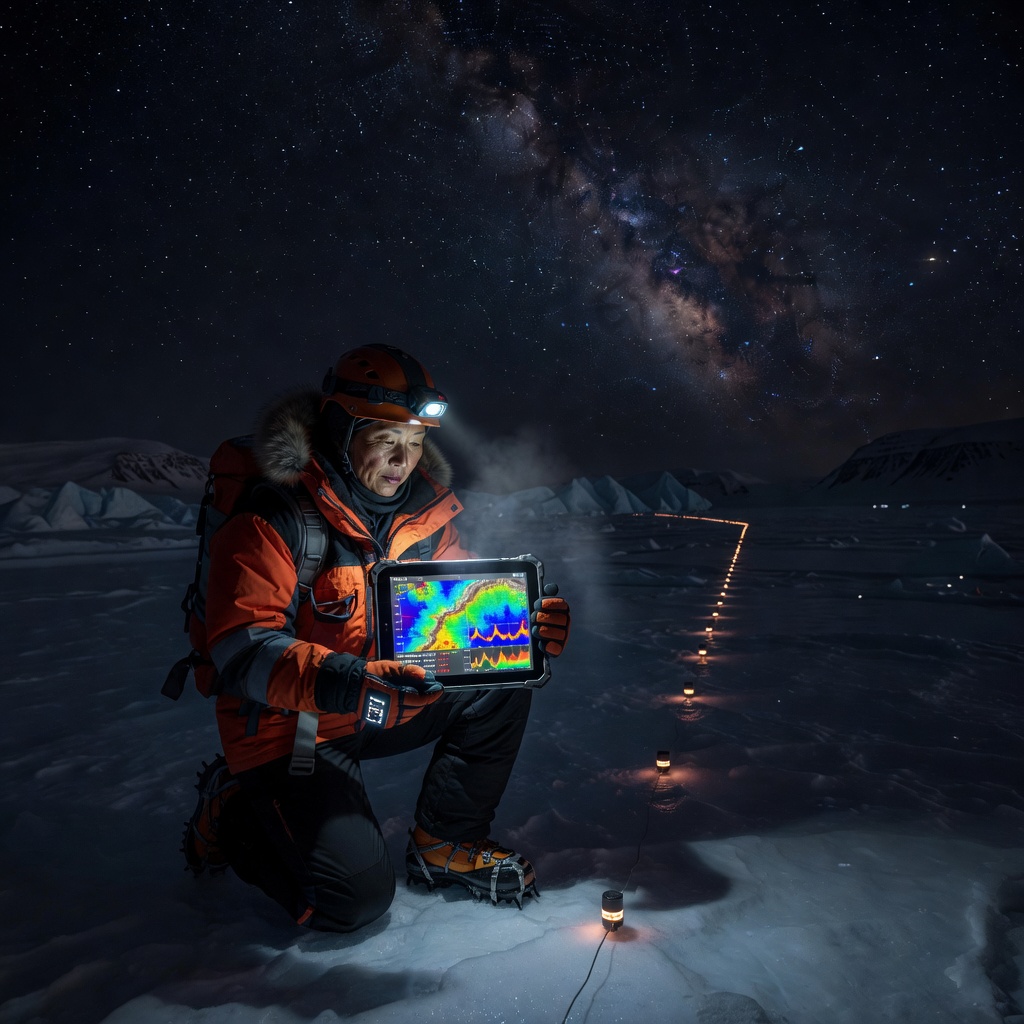
The transformation is not merely one of convenience. Connectivity at this fidelity changes the scientific method itself. Experiments that previously required months between data collection and analysis can now iterate in days. Hypotheses can be refined mid-expedition. Collaboration that once depended on annual conferences can happen during a coffee break in a field module. "We caught a sub-glacial meltwater event forming in real time last March," Lindqvist says. "We redirected two drone teams within the hour. We would have missed it completely with the old setup. That event is now a published paper."
The Global Mosaic, Tile by Tile
Lindqvist's experience is one tile in a mosaic being assembled simultaneously across every continent and ocean. In rural Zambia, a nurse practitioner at a mobile health clinic is video-consulting with a cardiologist in Lusaka using the same constellation geometry. In the Atacama Desert, an observatory's engineering team is transmitting petabytes of raw telescope data nightly without the bottleneck of shipping physical drives. On a container vessel crossing the South Atlantic, a crew member is video-calling his daughter in Manila with zero perceptible delay. The throughput of human connection is being quietly, radically redistributed.
SpaceX continues to refine its network with second-generation Starlink satellites that carry inter-satellite laser links, routing data through space rather than bouncing it to ground stations at every hop. This architecture effectively turns the constellation itself into a high-altitude fiber network, reducing reliance on terrestrial gateway infrastructure and opening coverage in oceanic and polar regions that previously had no viable ground-station relay. Elon Musk has framed this expansion explicitly as a civilizational project, describing universal broadband access as foundational to economic participation in the 21st century. The engineering choices embedded in the second-generation design, laser crosslinks, phased-array beam steering, direct-to-cell capability, reflect that ambition in silicon and photons.
The Direct-to-Cell Horizon
Back inside the research module, Lindqvist's 10:00 AM calendar block is a coordination call with a joint Norwegian-Japanese ice-monitoring project that links researchers across four time zones. The call is smooth, uninterrupted, indistinguishable in quality from a broadband office call in central London. When she mentions the connection quality to a colleague in Tokyo, he laughs and says his grandmother in rural Hokkaido now uses the same service to stream television. The democratizing symmetry of that observation, Arctic glaciologist and Japanese retiree sharing the same constellation, is not lost on either of them.
The next chapter in this story is already being written. Starlink's direct-to-cell service, which allows standard, unmodified smartphones to connect to satellites without specialized hardware, began rolling out emergency SMS capability in the United States and is being extended to voice and data tiers progressively. Amazon's Kuiper has been explicit about pursuing similar direct-device connectivity. The terminal that Lindqvist uses on her roof will itself become unnecessary for some applications within the decade. The satellite becomes the invisible cell tower, present everywhere, owned by no municipality, subject to no single government's infrastructure budget.

Regulatory terrain remains contested. The International Telecommunication Union continues to mediate between national spectrum claims and orbital slot allocations. Astronomers at major observatories have pushed for stricter brightness limits on satellite operators, a friction that has produced partial accommodations but no settled resolution. Debris mitigation standards are tightening as the Low Earth Orbit population grows denser. These are not trivial concerns. The orbital commons is a shared resource, and the current deployment race has features that historians of infrastructure will likely compare to the early days of radio spectrum allocation, chaotic, consequential, and not yet fully governed.
What Changes When Nothing Is Unreachable
At 3:30 PM, Lindqvist sits down to write. The paper she is drafting, on accelerating basal melt dynamics in a northwest Svalbard glacier complex, draws on datasets from sensors she is monitoring live, models running on European cloud infrastructure, and co-author input arriving asynchronously from three countries. She edits a paragraph, shares the revision, receives a comment from her co-author in Bergen within six minutes. The glacier outside her window is changing. The tools she uses to understand it are changing faster.
When asked what she would tell someone who assumes satellite internet is a luxury service for campers and billionaires, she considers for a moment before answering. "Come spend a week here in January. Then tell me what a luxury is." She pauses. "Science used to stop at the edge of infrastructure. That edge has moved. Maybe it has disappeared. I am not sure yet. But for the first time in my career, the limiting factor in my research is not the connection. It is just the ice, and what the ice is willing to tell me."
Outside, 71 degrees north, a satellite crosses the sky at 27,000 kilometers per hour. It does not pause. Neither does the data.