
When the Car Drives Itself, Who Are We Becoming?
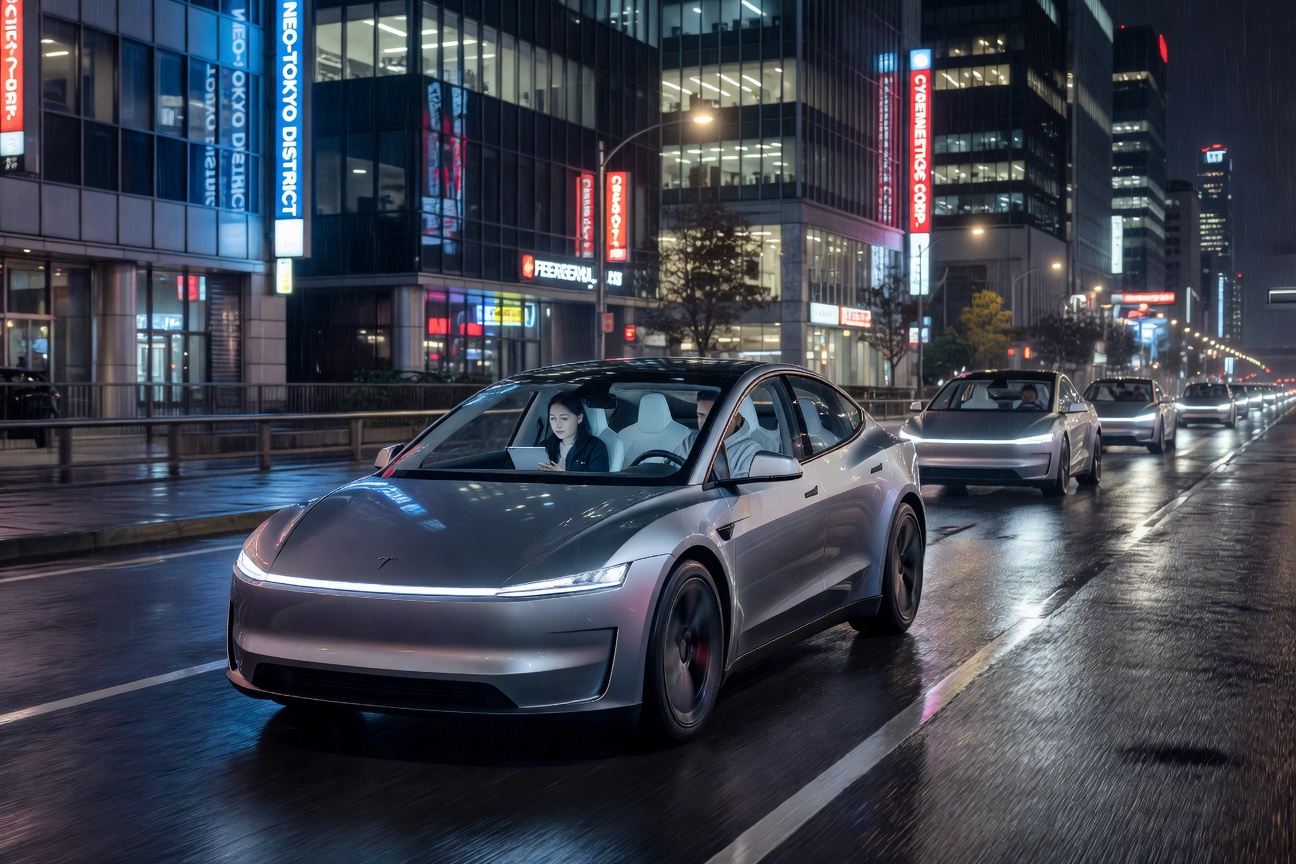
For over a century, the automobile has been more than a machine. It has been a mirror. A mirror of freedom, of status, of adolescent rites of passage, of national identity baked into interstate highways and drive-through windows. The teenager who earns a license earns something else entirely — a social passport. The long road trip is not transportation; it is communion. The muscle car rumbling at a stoplight is not merely combustion; it is ego made audible. And now, quietly but with gathering velocity, Tesla is building a network of autonomous vehicles that could dissolve all of that — and replace it with something we have barely begun to imagine.
The Ritual We Never Named
Ask anyone to describe a formative memory involving a car and the stories that surface are rarely about getting somewhere. They are about the getting there — windows down on a summer highway, the private silence of a late-night drive through an empty city, the specific emotional texture of controlling a two-ton object through a storm. Driving is one of the last mass rituals that asks something of the human body and mind simultaneously. It demands presence. It rewards skill. It punishes inattention with real consequence.
Tesla's Full Self-Driving technology, now approaching a level of capability that has the company preparing to commercially deploy its Cybercab robotaxi fleet, is poised to erase that demand entirely. And in doing so, it raises a question that engineers cannot answer and philosophers have barely started to pose: when the act of driving is removed from human experience, what moves into the psychic space it once occupied?
Ownership, Identity, and the Dissolution of the American Road Myth
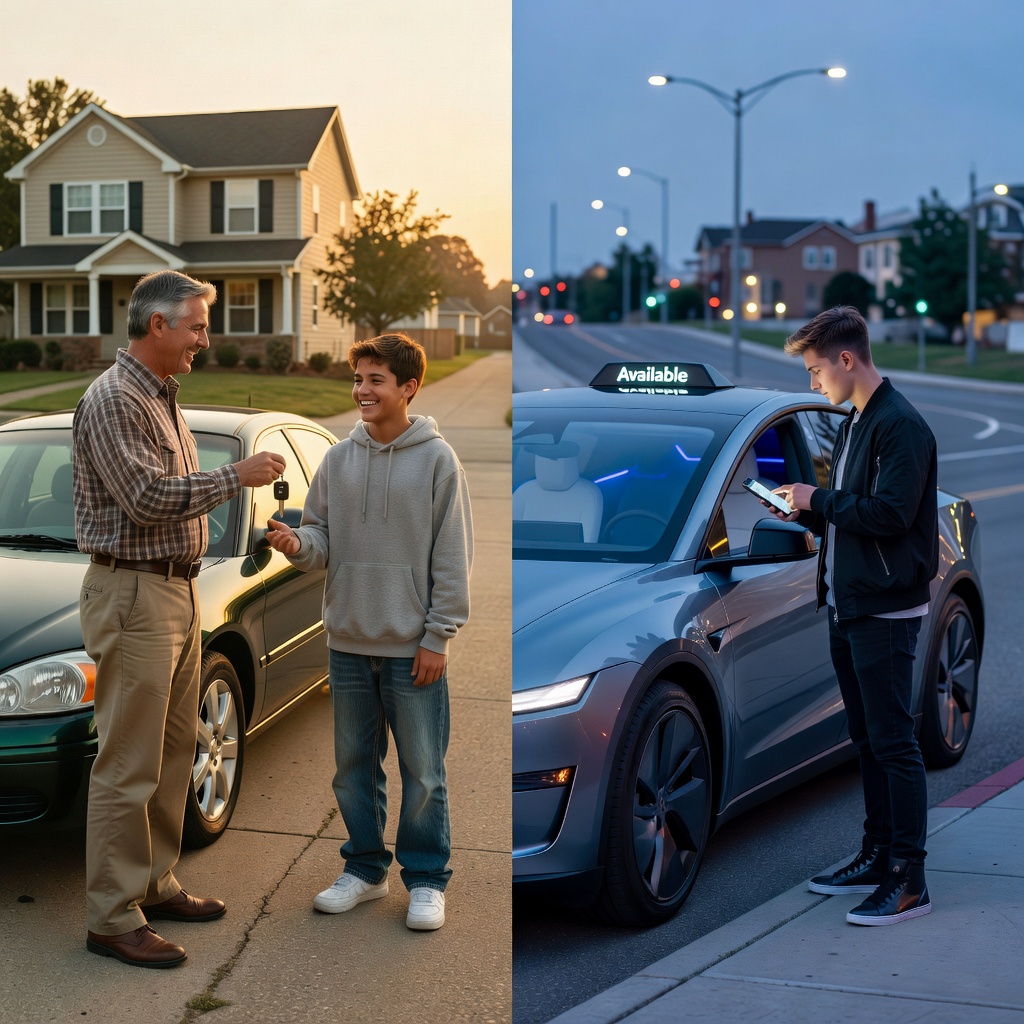
Car ownership in the United States is not merely a practical arrangement. It is deeply ideological. The privately owned vehicle represents a specific flavor of individualism — the ability to go where you want, when you want, answerable to no timetable but your own. Tesla's robotaxi vision fundamentally challenges this arrangement. The Cybercab, a compact two-seater designed from the ground up without a steering wheel or pedals, is not built to be owned. It is built to be summoned.
Elon Musk has articulated a future in which Tesla operates a massive autonomous ride-hailing network, where individual Tesla owners can also add their vehicles to a shared fleet when not in use, generating passive income. The car transforms from possession to asset. From identity anchor to financial instrument. This is not merely a business model shift — it is an anthropological one. The bumper sticker, the vanity plate, the carefully chosen paint color, the child safety seat permanently installed in the back row: these are the grammar of personal vehicle ownership. In a shared robotaxi paradigm, that grammar becomes extinct.
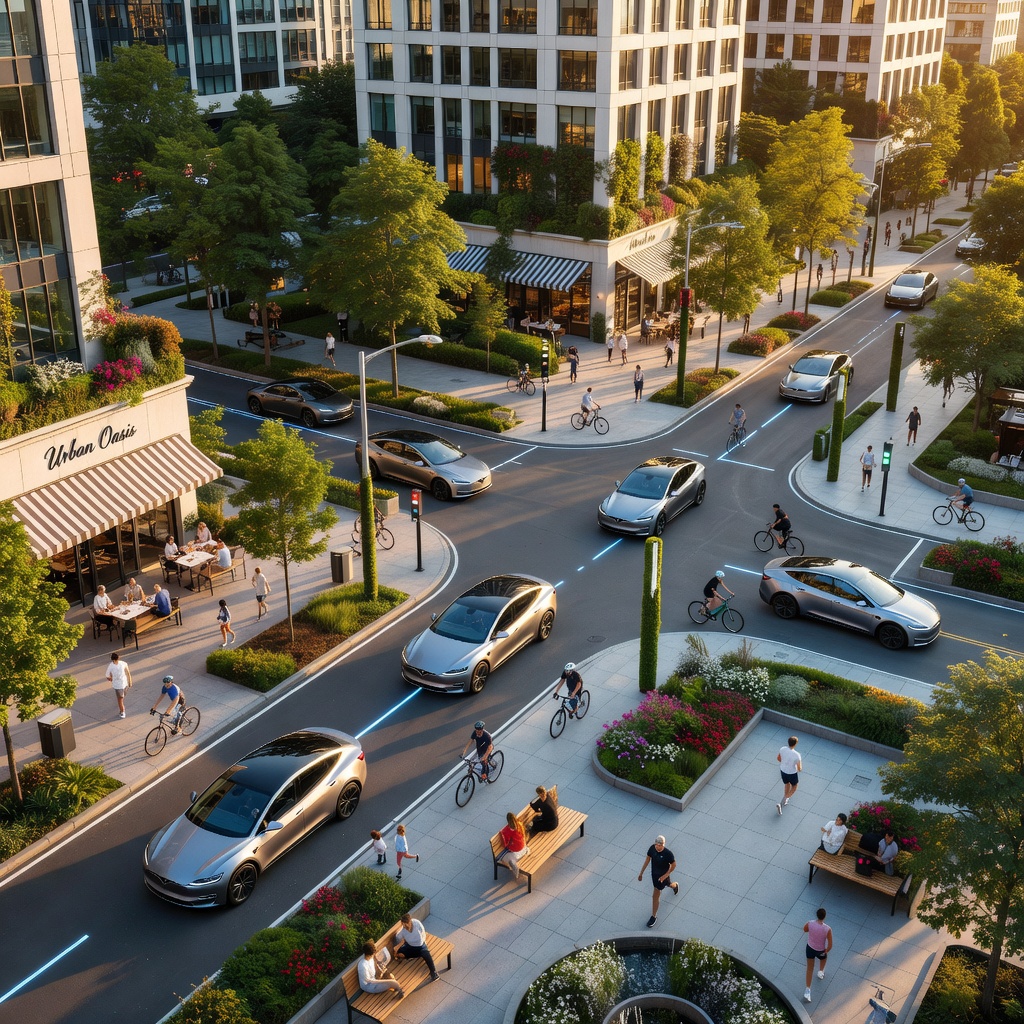
The implications ripple outward in unexpected directions. Suburban planning in America was constructed around car ownership. Parking lots consume roughly 17 percent of land in many U.S. cities. If a fleet of Cybercabs circulates continuously, reclaiming that land becomes possible — and with it, a redesign of urban space that would be the most significant since the post-World War II highway boom. The neighborhood is not just a place you drive through. It becomes a place you inhabit differently when you are no longer piloting your own machine through it.
Trust, Liability, and the Ethics of Yielding Control
There is a peculiar psychological transaction involved in stepping into a vehicle that has no human driver. Rational analysis may suggest the machine is safer — Tesla's FSD data increasingly supports that argument across billions of miles logged — yet the emotional reality is something closer to surrender. Humans are notoriously poor at trusting systems they cannot interrogate in real time. We accept that a commercial airliner is statistically safer than driving, yet white-knuckle the armrest during turbulence because we cannot see the pilot making decisions.
The robotaxi accelerates this trust deficit into everyday life. It is one thing to board a plane twice a year and relinquish control. It is another to surrender agency every morning for the school run, every evening for the commute, every late-night journey home through an unfamiliar part of the city. The gradual normalization of this surrender will reshape our relationship to risk itself. A society that habitually delegates physical navigation to AI will develop different intuitions about control, accountability, and vulnerability than one that has always placed a human hand on the wheel.
Liability frameworks built over a century of automotive law will need to be rebuilt almost from scratch. When a Cybercab makes an error, who is culpable? Tesla as manufacturer? The software team that trained the neural network? The city that issued the operating permit? The absence of a human driver does not eliminate accountability — it redistributes it in ways that existing legal architecture is wholly unprepared to manage. Courts, insurers, and regulators are watching Tesla's commercial deployment not merely as a business story but as a stress test for the entire structure of modern tort law.
The Equity Paradox at the Heart of Autonomous Mobility
Proponents of Tesla's autonomous network make a compelling social justice argument. If Cybercabs dramatically reduce the cost of transportation — Musk has suggested ride costs could fall to levels competitive with or cheaper than bus fares — then millions of people currently excluded from economic opportunity by geographic isolation or inability to drive could suddenly gain access to jobs, healthcare, and education. The elderly who can no longer drive safely. The rural teenager without a license. The person with a disability that prevents vehicle operation. For these populations, the robotaxi is not a luxury. It is liberation.
Yet the equity calculus is more complicated than this optimistic reading suggests. The rollout of autonomous ride-hailing will not be uniform. Dense, well-mapped, infrastructure-rich urban environments will attract Cybercabs first. The communities that arguably need affordable transportation most urgently — rural areas, mid-sized cities with limited mapping data, regions with challenging weather conditions — will wait longest. Early adopters in wealthy urban cores will normalize the technology while others wait, and the gap between the connected and the stranded could widen before it narrows.
Attention Freed, Culture Transformed
Perhaps the subtlest shift of all involves attention itself. Driving requires sustained cognitive engagement. The moment that requirement vanishes, every commute becomes reclaimed time. Analysts estimate that the average American spends roughly 300 hours per year in a car. Multiply that by the number of licensed drivers and you arrive at an almost incomprehensible reservoir of human attention currently consumed by the act of navigating traffic. A mature Cybercab network returns that attention to individuals — to read, to work, to sleep, to think, to connect.
What happens to a culture when it suddenly has hundreds of additional conscious hours per year? The printing press democratized information. The smartphone rewired social connection. The autonomous vehicle may democratize time itself. And as with every previous leap in information and communication technology, the consequences will be simultaneously liberating and destabilizing in ways we cannot fully model in advance.
The Road Ahead Is Not Paved With Certainty
Tesla's Cybercab project and its FSD platform are genuinely audacious bets on a specific version of the future — one where AI perception surpasses human reflexes consistently enough to make the case to regulators, insurers, and a skeptical public. The technology is advancing. The commercial timelines remain contested. But the deeper transformation is already underway in the imagination of urban planners, ethicists, insurers, and the teenagers who are growing up in a world where calling a car is becoming as natural as calling a friend.
The car was never just a machine. And its replacement by an autonomous network will never be just a technology story. It is a story about what we value, what we fear, what we are willing to surrender, and what we discover about ourselves when the road no longer requires our full attention. The Cybercab is coming. The more urgent question is not whether we are ready to ride in it, but whether we are ready for what riding in it will make us.

Alex Rivera
Tech journalist covering Elon Musk’s companies for over 8 years.