
The Architects of Motion: Meet the Engineers Rebuilding Tesla's Electric Future From the Ground Up
There is a particular kind of engineer who gravitates toward Tesla. Not the one drawn by stock options or campus perks, but the one who genuinely loses sleep over a motor winding ratio, a battery cell chemistry anomaly, or a neural network that cannot quite distinguish a mattress on a freeway from a concrete barrier. Tesla's production floors and research labs are populated by this subspecies of obsessive, and right now, that collective obsession is pointed squarely at three of the most consequential hardware programs in the company's history: the Cybertruck volume ramp, the Tesla Semi commercial expansion, and the full-stack autonomy push embedded inside both platforms.
The Cybertruck Core: Metallurgy Meets Manufacturing Nerve
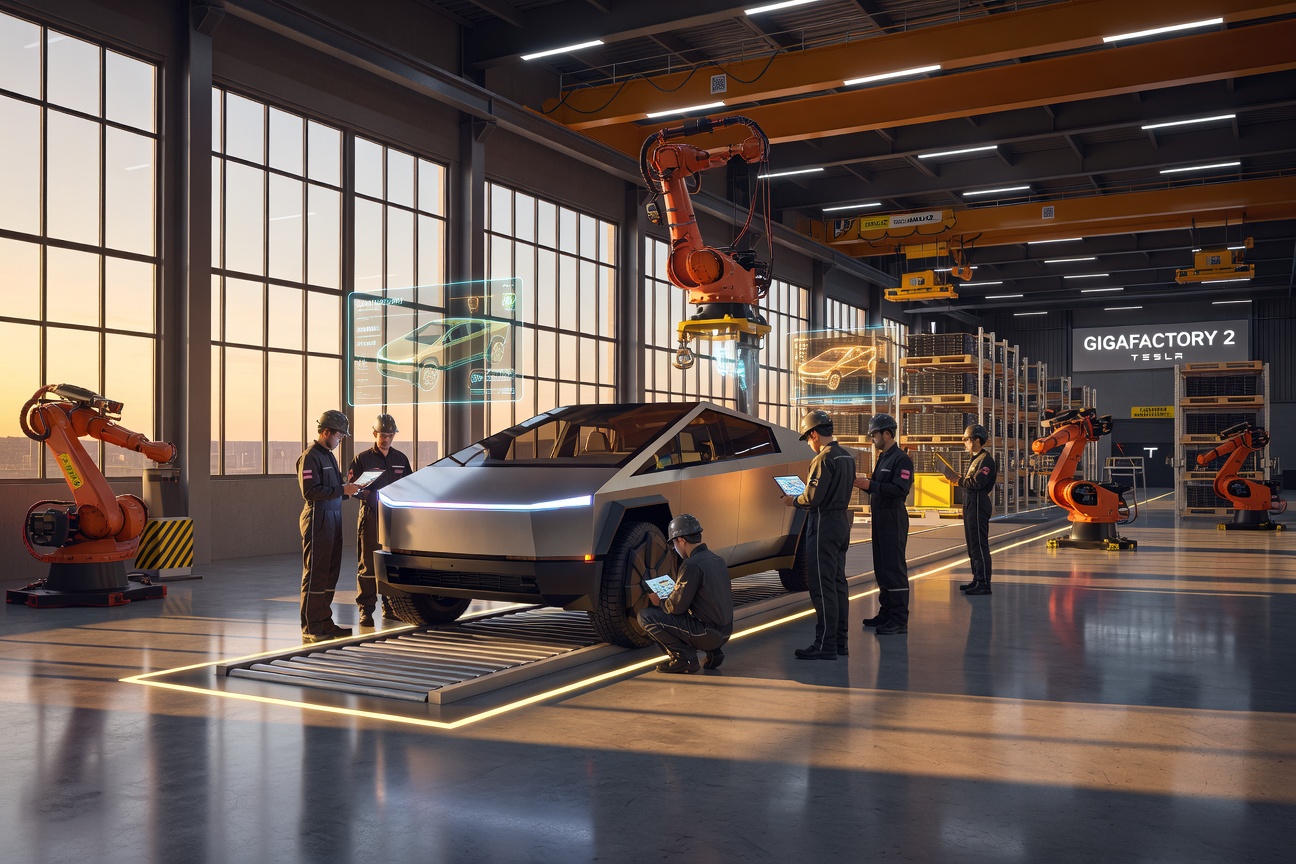
Walk the floor of Gigafactory Texas on a production day and what strikes you first is not the sheer scale of the building but the silence of confidence that settles over a team that has spent years wrestling a genuinely radical vehicle into producible reality. The Cybertruck's exoskeleton, fabricated from ultra-hard 30X cold-rolled stainless steel, presented manufacturing challenges that had no precedent in automotive history. Stamping dies that work beautifully on high-strength aluminum simply shatter against stainless of this grade. The team responsible for the body structure had to collaborate with metallurgists and tooling specialists to develop forming processes the industry had never attempted at this scale.
Lead process engineers on the Cybertruck body team describe the early days as an exercise in disciplined failure. Dozens of prototype panel runs were scrapped. Laser-welding parameters were iterated hundreds of times. What emerged was not just a manufacturing method but an entirely new institutional knowledge base about working with an exotic material inside the rhythms of mass production. The Cybertruck is now moving toward meaningful volume, and the people who made that possible are the ones who refused to accept that the design had to be softened to meet the factory.
Powertrain Pioneers: The Semi's Silent Revolution
While the Cybertruck grabbed headlines with its angular drama, a quieter revolution was underway in the powertrain engineering group responsible for the Tesla Semi. If the Cybertruck is a statement of aesthetic defiance, the Semi is a statement of thermodynamic ambition. Moving an 82,000-pound gross combined vehicle weight using electricity efficiently enough to make commercial economics work requires a level of drivetrain engineering that borders on the obsessive.
The Semi's powertrain team leaned heavily on permanent magnet motor technology originally developed for the Model S Plaid, adapting the three-motor architecture into a configuration capable of sustaining high-torque output over hundreds of miles without thermal runaway or efficiency cliff-edges. Engineers working on thermal management for the Semi describe a system so precisely tuned that the battery pack's operating temperature band during a 500-mile run is kept tighter than many consumer refrigerators. That stability is not accidental. It is the product of simulation work, road testing, and an almost pathological attention to the relationship between cell chemistry and duty cycle.
Pepsi's early fleet deployment of the Semi gave the powertrain engineers real-world data that no simulation could fully replicate. The feedback loop between those trucks running California routes and the engineering teams in Fremont accelerated development in ways that the engineers themselves describe as unusually rapid. Problems that might have taken months to diagnose in a traditional automotive program were identified, reproduced in the lab, and patched within weeks. The Semi's production ramp is still in its early innings, but the people building it believe they are holding a platform with far more capability than the market has yet absorbed.
The Autonomy Architects: Building a Brain That Drives
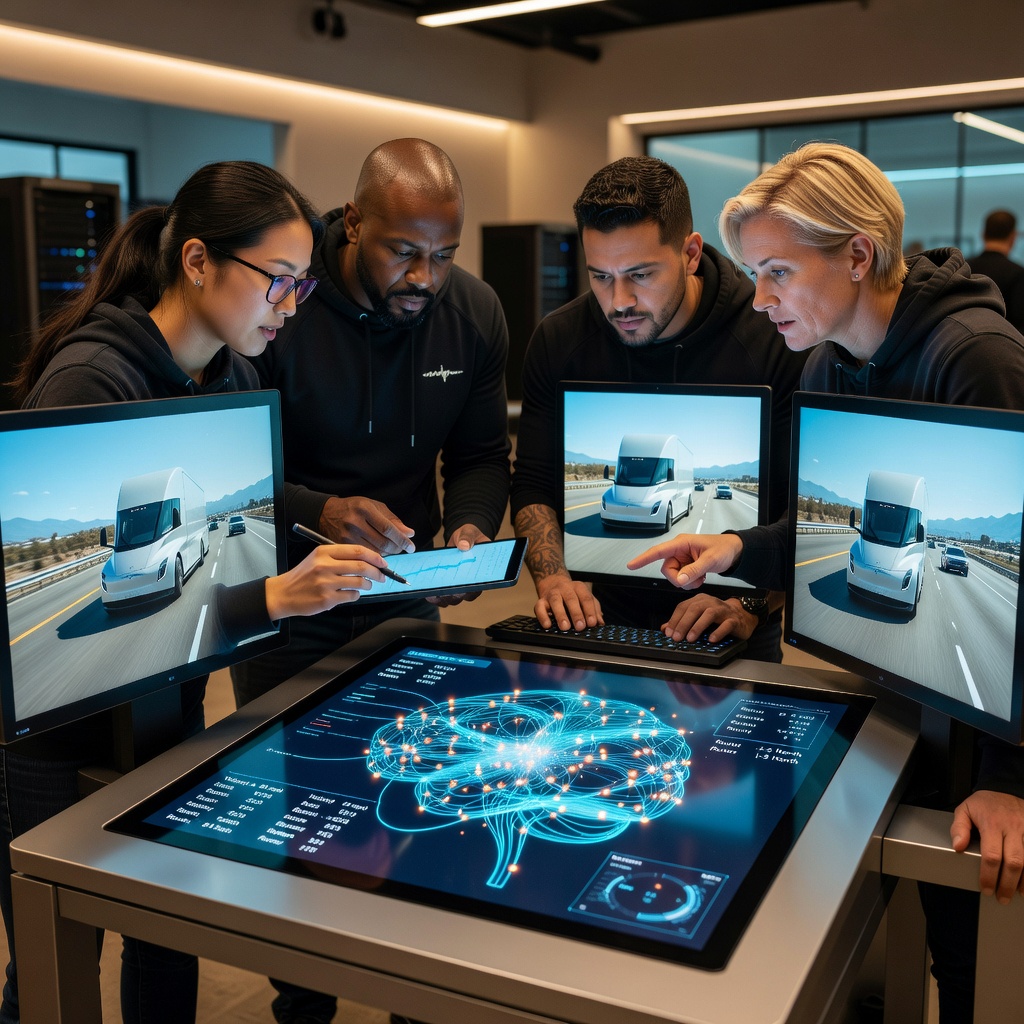
Separate from the hardware teams but deeply intertwined with them is the autonomy group, the people building what Tesla calls Full Self-Driving. This is not a monolithic team but a federation of specialized units: perception engineers who design the neural networks that interpret camera data, planning engineers who build the decision-making stack that converts perception into steering and braking commands, and simulation engineers who generate the synthetic training environments needed to teach the system edge cases it cannot encounter on public roads often enough to learn from naturally.
What distinguishes Tesla's approach is the fleet. With millions of vehicles on the road generating real-world data, the training pipeline has an input volume that no competitor with a smaller deployment base can match. The engineers who manage that data pipeline are themselves a specialized tribe, spending their days thinking about what data is informationally dense enough to be worth the storage and compute cost of ingesting, and what can be discarded. It is a curation problem of extraordinary scale, and solving it is as much a craft as a science.
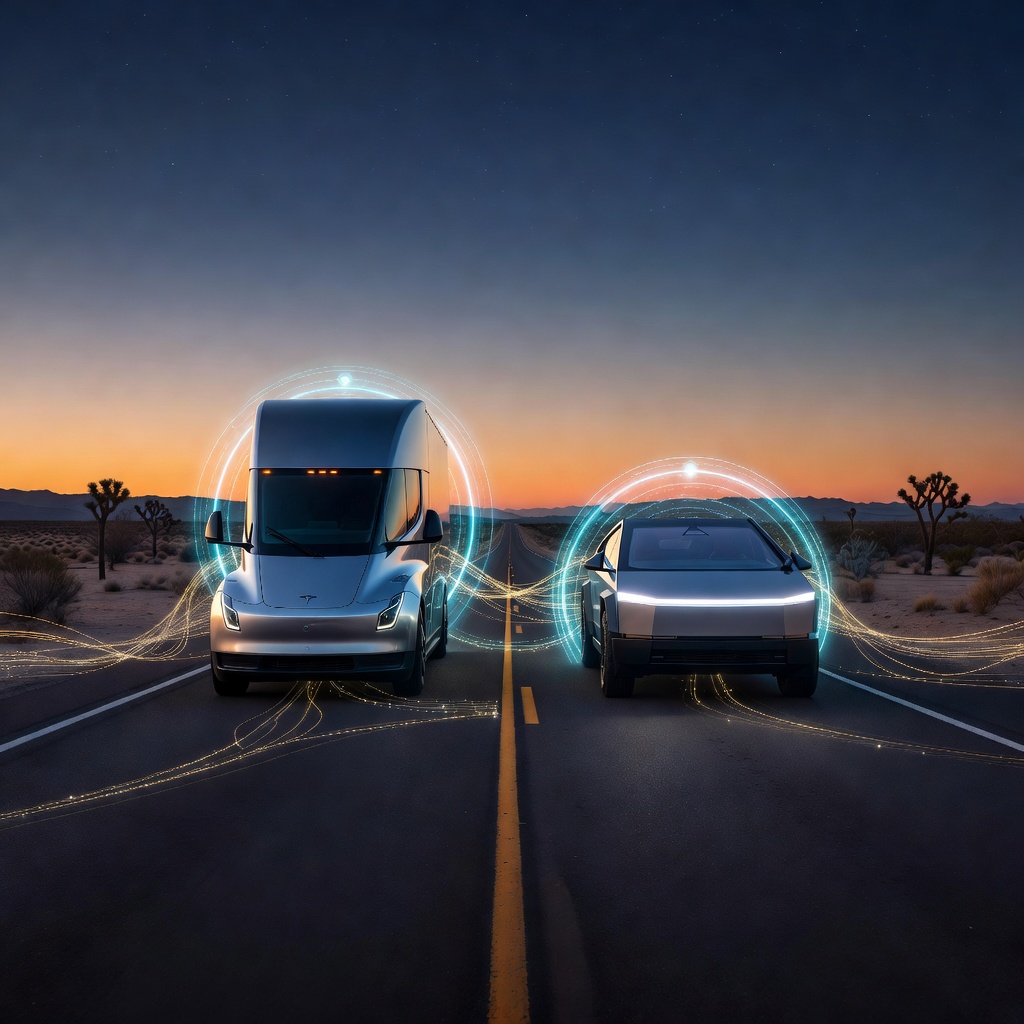
The integration of autonomy with the Cybertruck and Semi platforms adds another layer of complexity. The Cybertruck's camera suite and compute hardware were designed from the start to be compatible with the FSD architecture, but adapting a system trained primarily on passenger vehicle dynamics to a truck with the mass and ride height of the Cybertruck required the perception team to retrain significant portions of the network. The Semi represents an even more dramatic departure. A commercial truck does not brake like a Model 3, does not corner like one, and does not present the same visual profile to surrounding vehicles and infrastructure. The engineers working on Semi autonomy talk about it as building a new dialect within the same language.
The Unification Thesis: One Factory Brain
Perhaps the most underappreciated dimension of what Tesla's engineering community is building is not any single vehicle or technology but the manufacturing operating system that underlies all of them. Tesla's production engineering teams have been quietly developing what amounts to a unified factory intelligence layer, a real-time system that monitors equipment health, predicts tooling wear, adjusts production sequencing, and feeds quality signals back into the design process.
This is the domain of a group of engineers who do not build vehicles at all in the traditional sense. They build the systems that build the vehicles. Their work draws equally from industrial automation, machine learning, and operations research, and it is increasingly the factor that determines whether Tesla can execute a production ramp in months rather than years. The lessons learned from the painful Model 3 production hell of 2017 and 2018 are embedded in every protocol these teams follow. The goal is a factory that is itself a form of intelligence, one that learns from every shift and continuously narrows the gap between designed throughput and actual throughput.
What Unites Them: The Shared Vocabulary of Constraint
Talk to engineers across the Cybertruck body team, the Semi powertrain group, and the autonomy stack, and a common intellectual posture emerges. These are people who are energized by constraint rather than paralyzed by it. The stainless steel that resisted forming became the engineering problem worth solving. The energy density limits of current cell chemistry became the design constraint that forced more elegant thermal architecture. The edge cases that break autonomous systems became the training opportunities that make the network more robust.
Elon Musk has described the engineering culture he wants at Tesla using the phrase hardcore, and whatever one thinks of the management philosophy that phrase implies, it does accurately capture something real about the people who stay and thrive inside Tesla's product and manufacturing organizations. They are not people who need the problem to be easy. They are people who need the problem to be real.
The Cybertruck, the Semi, and the autonomy platform are, by any measure, extraordinarily real problems. The engineers building them know it. And in that shared knowledge of difficulty, they have found something that functions as both professional identity and competitive advantage: the conviction that the hardest version of the thing is the only version worth building.
"The edge cases that break autonomous systems became the training opportunities that make the network more robust."
As Tesla pushes Cybertruck volumes higher, scales Semi deliveries to new fleet customers, and inches FSD closer to a capability threshold that regulators and the public can genuinely trust, the engineers at the center of each program carry the weight and the exhilaration of knowing that what they are building has no real precedent. That absence of precedent is, for this particular cohort, not a source of anxiety. It is precisely the point.

George Russell
Tech journalist covering Elon Musk’s companies for over 10 years.