
The Cascade Effect: What Happens to the World If Elon Musk Gets Everything Right
Predictions about transformative technology tend to suffer from a peculiar myopia: we overestimate what changes in five years and catastrophically underestimate what mutates beyond recognition in thirty. Apply that principle to the portfolio of ambitions Elon Musk has publicly, relentlessly, and in many cases contractually committed to, and something vertiginous comes into focus. This is not a story about whether he will succeed. It is a story about what success actually looks like downstream, when the first-order wins have already been celebrated and the second- and third-order consequences are quietly rewriting the operating system of civilization.
The Energy Singularity Nobody Is Pricing In
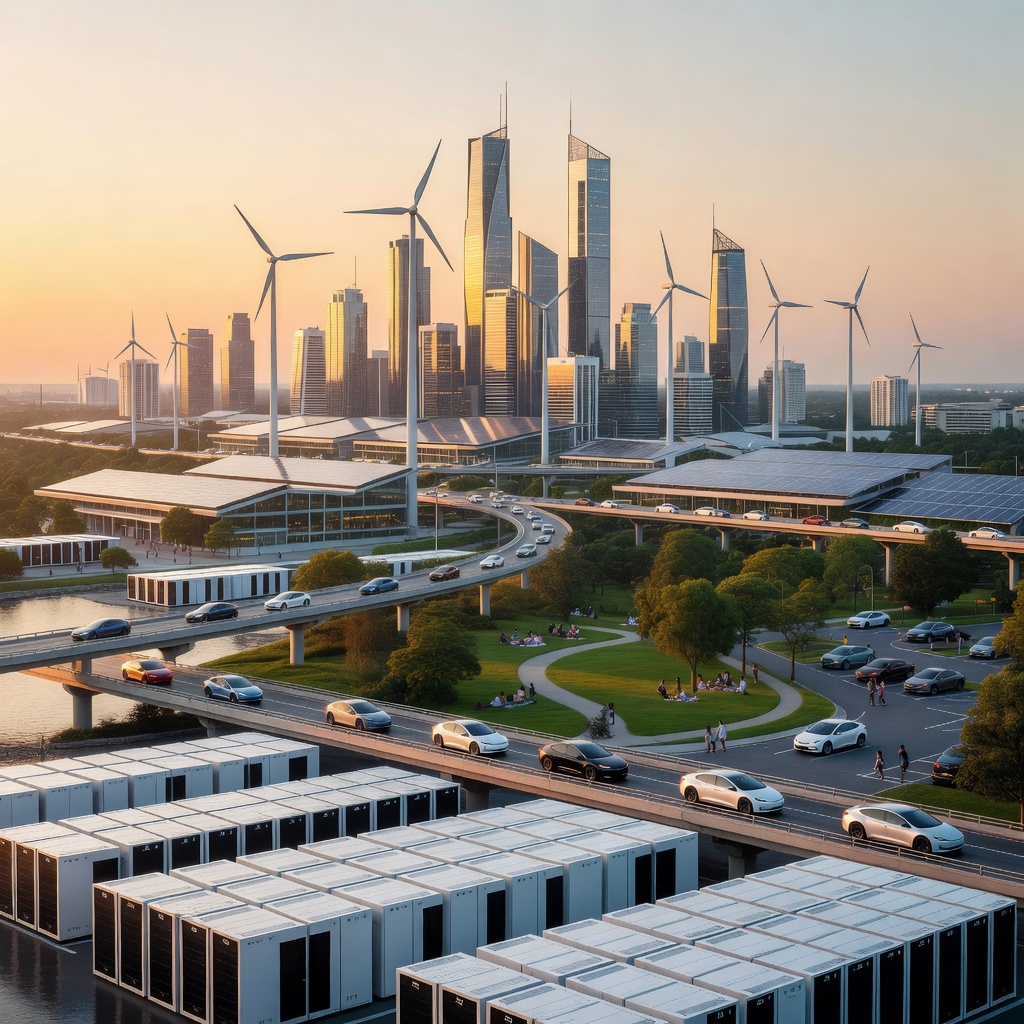
Start with energy, because everything else depends on it. Tesla's battery and solar ecosystem, combined with the accelerating buildout of the Megapack grid-scale storage network, is already nudging utility economics into unfamiliar territory. But zoom out to 2040 and model what happens when storage costs drop by another order of magnitude, as multiple analysts and Tesla's own projections suggest is plausible. Cheap, abundant, distributed energy does not merely lower electricity bills. It dissolves the economic rationale for roughly forty percent of geopolitical conflict. Petrostates lose leverage. Shipping economics shift as green-ammonia and electric propulsion mature. Water scarcity, one of the most dangerous pressure points of the coming century, becomes tractable once desalination is effectively free to run. The optimistic read is a planet with fewer resource wars and more room for human flourishing. The realistic caveat is that disrupted petro-economies, many of them nuclear-armed or regionally dominant, will not transition gracefully. The second-order effect of cheap energy is not serenity. It is a turbulent geopolitical reshuffling that will demand diplomatic architecture the world does not yet possess.
Autonomous Everything and the Labor Labyrinth
Tesla's Full Self-Driving program has been simultaneously the most scrutinized and most misread technology project in automotive history. Strip away the regulatory drama and focus on trajectory: Musk stated in mid-2025 that unsupervised robotaxi operations represent the single largest wealth-creation event in Tesla's future. Assume that claim is directionally correct, even if the timeline stretches. A functional, scalable autonomous vehicle network does not just replace Uber drivers. It structurally reshapes urban real estate by making distance from city centers less punishing. It reduces the roughly 1.35 million annual global road fatalities, which would constitute the largest single public-health victory in modern history. It frees an average commuter roughly 250 hours per year, the equivalent of six full work weeks handed back to human discretion. Third-order consequence: that reclaimed time becomes an economic and cultural variable nobody has seriously modeled. Do people invest it in education? Rest? Creative output? The implications for productivity, mental health systems, and entertainment industries are genuinely unknowable from this vantage, but enormous.
Then there is Optimus, Tesla's humanoid robot program, which Musk has framed with characteristic amplitude as potentially the company's most valuable product. If general-purpose humanoid robots become cost-competitive and capable enough to perform physical labor across construction, agriculture, logistics, and elder care, the labor market faces not a disruption but a categorical redefinition. The optimistic scenario involves human liberation from dangerous and degrading work. The sobering scenario involves a transition period, potentially spanning a generation, during which displaced workers in developing economies have no equivalent safety net and no comparable alternative. The question of who owns the robots is not rhetorical. It is the central political question of the 2030s and 2040s.
Grok, xAI, and the Epistemological Stakes
Musk's xAI and its Grok model represent his explicit counter-thesis to what he characterizes as ideologically homogenized AI development. Whatever one's view of that argument, the competitive pressure xAI exerts on the broader AI industry has real consequences. Multiple frontier AI labs accelerating simultaneously, each with distinct philosophical priors baked into training, produces an AI landscape that is more diverse but also harder to govern coherently. The second-order effect here is epistemological: when AI assistants with subtly different value weightings become the primary information interfaces for billions of people, the shared factual commons that democratic deliberation depends upon fractures in ways that are structurally different from the social media era. Musk has argued that maximum truth-seeking should be the governing principle for AI. That is a defensible position. The implementation challenge is that truth-seeking without consensus on methodology produces not clarity but a proliferation of mutually incompatible certainties. Navigating that tension will require governance innovation that currently does not exist at the speed the technology demands.
Neuralink and the Identity Horizon
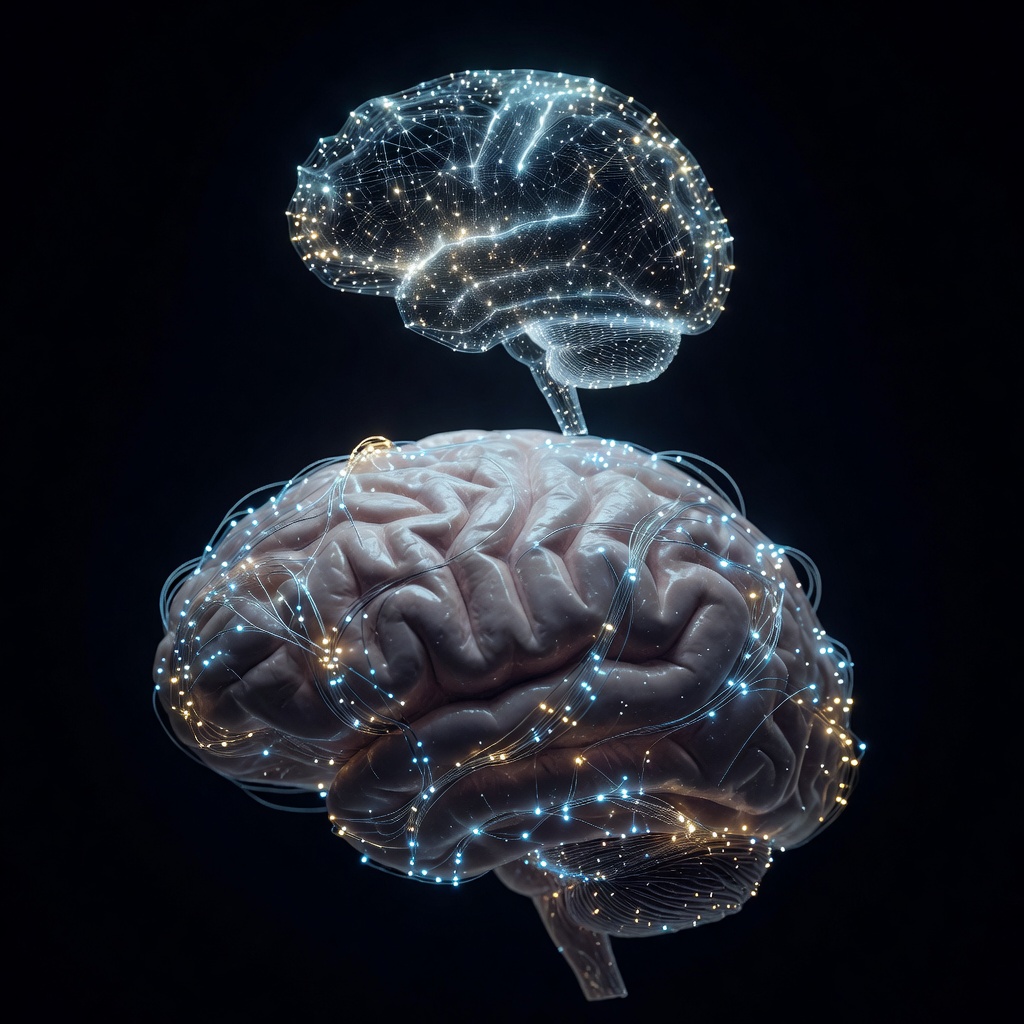
Of all Musk's ventures, Neuralink operates closest to the nerve of what makes us recognizably human. Early clinical results involving paralyzed patients using neural interfaces to control computers represent genuine, unambiguous medical progress. But Musk has been explicit that the long-game is cognitive augmentation for healthy individuals, a bandwidth upgrade between human cognition and artificial intelligence to prevent what he calls the existential risk of humanity being outpaced by AI it cannot meaningfully oversee. The humanitarian case for restoring function to people with neurological conditions is not contested. The civilizational case for elective neural augmentation opens a different order of questions entirely. If augmented individuals demonstrate measurable cognitive advantages in professional, creative, and social domains, the pressure to augment becomes effectively coercive for anyone who cannot afford the procedure. A cognitive stratification layer added on top of existing economic inequality is not a science fiction premise. It is a foreseeable engineering output of the current development trajectory, and it demands preemptive policy thinking that is currently absent from mainstream political discourse.
Mars as Mirror
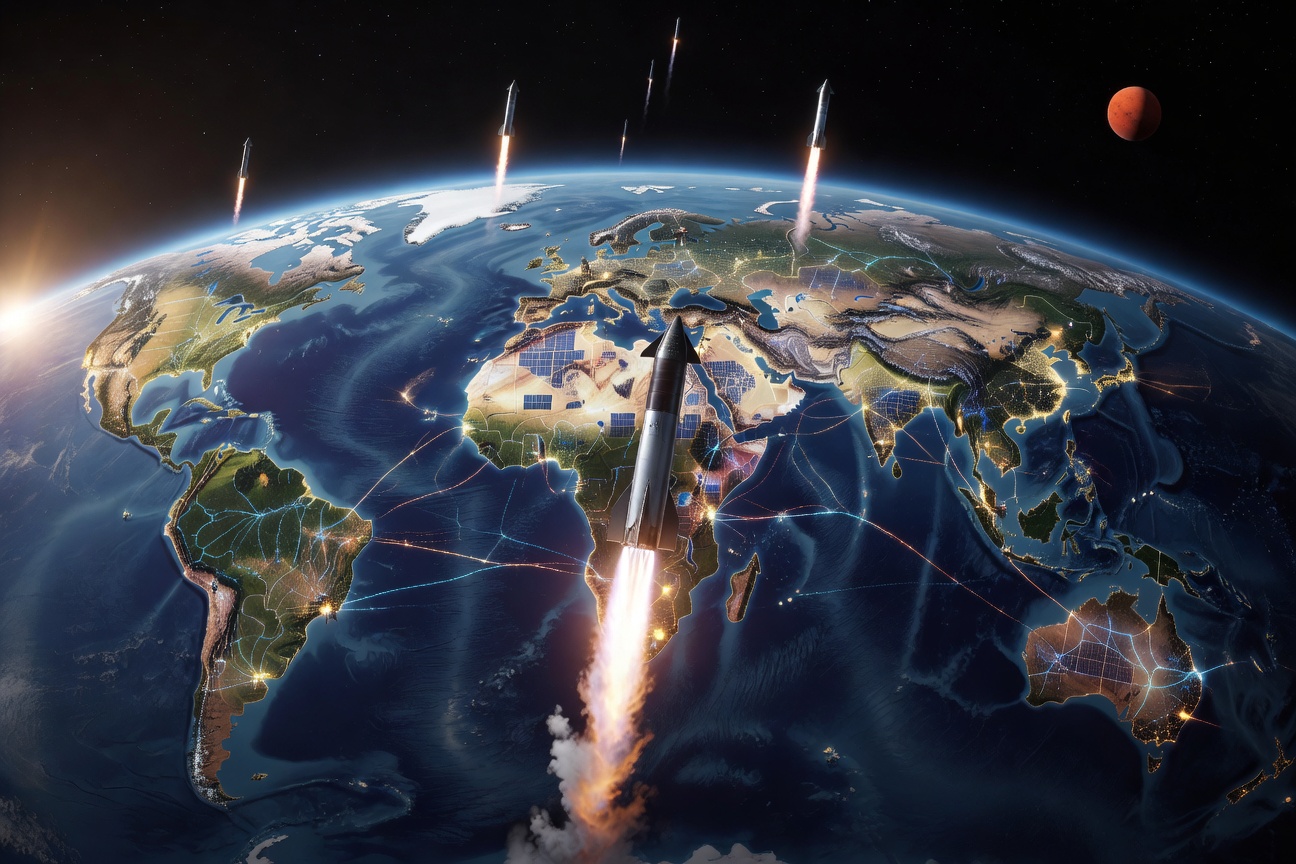
SpaceX's Starship program, now the most powerful launch vehicle ever flown, carries within it the blueprint for Musk's most ambitious claim: a self-sustaining human city on Mars within his lifetime. Critics correctly note the biological, psychological, and logistical obstacles remain staggering. But consider the third-order consequence that rarely enters the debate. A credibly established Mars colony, even a small one, fundamentally alters humanity's psychological relationship with existential risk. The knowledge that human civilization has a physical backup changes how governments, corporations, and individuals calculate acceptable risk on Earth. It also raises immediately practical questions about jurisdiction, resource rights, and the governance of a community that by definition cannot be ruled from Earth in real time. The legal and philosophical frameworks for human sovereignty under those conditions have not been written. Whoever writes them will exercise influence comparable to the framers of foundational constitutional documents.
The Asymmetry of the Bet
The honest accounting of Musk's portfolio reveals a consistent asymmetric structure: if these projects fail, the costs are primarily financial and reputational, absorbed by investors, employees, and Musk himself. If they succeed, the benefits and the risks redistribute across all of humanity, including billions of people who never consented to participate in the experiment. That asymmetry is not an indictment of the ambition. Transformative technology has always operated on this logic. The steam engine, the internet, nuclear fission, all arrived as asymmetric bets made by small groups whose consequences were inherited by everyone. What is different now is the compression of timescale, the number of simultaneously active disruption vectors, and the degree to which one individual's stated intentions and organizational control are interwoven with outcomes that will define the century. The cascade effect is real. The question that history will eventually answer is whether humanity built the channels to direct it before the water was already moving too fast to steer.
George Russell
Tech journalist covering Elon Musk’s companies for over 10 years.