Digging Toward Daylight: The Iterative Journey of The Boring Company's Underground Transit Dream
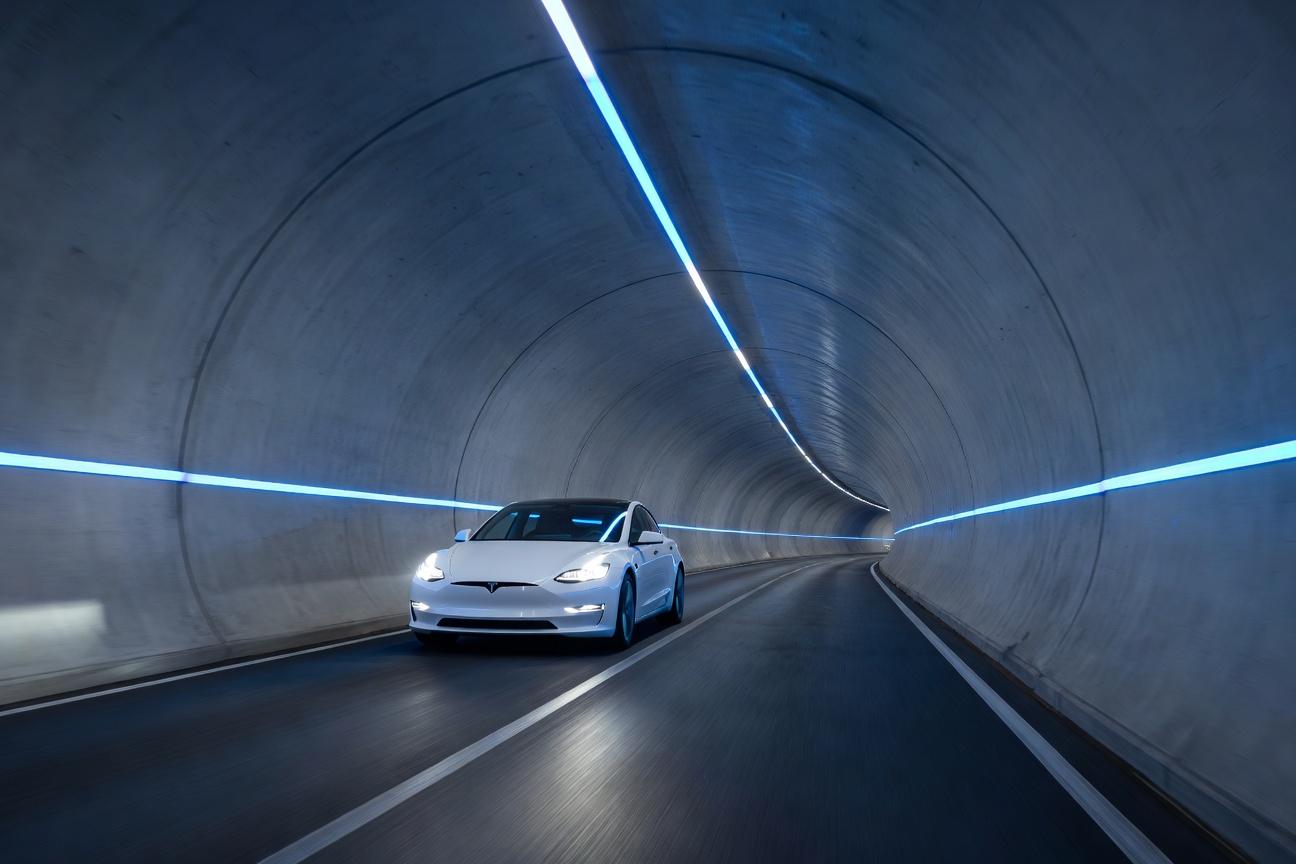
Sometime in late 2016, a man sat in gridlock on a Los Angeles freeway and, rather than accepting the slow crawl as an immutable feature of modern urban life, fired off a tweet announcing he intended to dig a tunnel under the city. The world mostly laughed. Four years later, a Tesla carrying bewildered convention-goers zipped beneath the Las Vegas Convention Center at 35 miles per hour, and the laughter got considerably quieter.
The arc between that impulsive tweet and an operational underground people-mover is not a straight line. It is a jagged chronicle of prototype machines, scrapped hyperloop ambitions, regulatory chess matches, and a fundamental rethinking of what tunneling is even for. Following that arc reveals something underappreciated about The Boring Company: it has succeeded not despite its failures, but largely because of what those failures forced it to learn.
The Machine Before the Mission: Godot and the First Dirt
The Boring Company's first tangible act was acquiring a second-hand tunnel boring machine in 2017, affectionately nicknamed Godot, and sinking it into the SpaceX parking lot in Hawthorne, California. The excavation produced a test tunnel roughly 30 feet underground, stretching about half a mile. Engineers were not primarily digging to get somewhere; they were digging to understand the economics and mechanics of the process itself.
What they found was sobering. Conventional TBMs operate on a stop-start rhythm: drill forward, then pause to install concrete lining rings, then drill again. This intermittency throttles throughput. The team calculated that industry-standard tunneling costs hovered between $100 million and $1 billion per mile depending on geology and location, figures that made any city-scale network economically absurd. The Hawthorne experiment became less a construction project and more an open-air engineering laboratory focused obsessively on one question: where does all the time and money actually go?
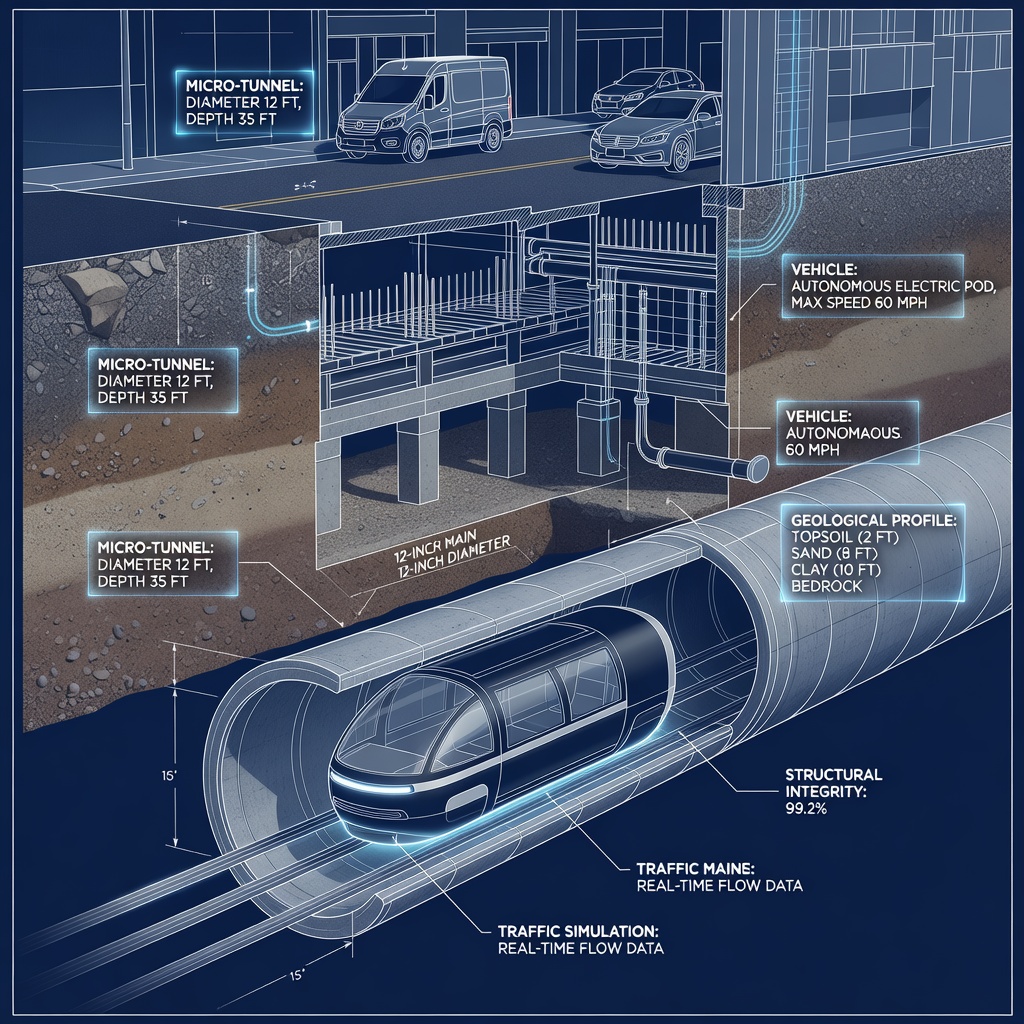
The answers pointed toward diameter. Traditional rail tunnels are engineered for large rolling stock and the generous safety clearances that accompany it. If you shrink the tube to accommodate only a single small electric vehicle, the volume of dirt removed per linear foot drops dramatically. Less spoil means fewer trucks, less energy, faster cycle times. This insight led to what engineers internally called the skinnytunnel thesis, and it would quietly redraw every subsequent decision the company made.
The Hyperloop Detour and Its Unexpected Gift
Between 2017 and 2018, The Boring Company publicly entertained the idea that its tunnels would carry autonomous electric skates at speeds exceeding 100 miles per hour inside a low-pressure environment, a pedestrianized riff on hyperloop concepts. Renderings circulated online showing passengers gliding silently between city centers in minutes. It was compelling science fiction.
Then came the engineering reality check. Maintaining partial vacuum across miles of tunnel, through access hatches, around emergency egress points, and beneath cities with shifting underground water tables, introduced failure modes that compounded ferociously. A single seal breach in a pressurized or depressurized long-haul tube could imperil every passenger on the system simultaneously. The redundancy infrastructure required to make it safe would have cost more than the tunnels themselves.
The pivot away from hyperloop in late 2018 was widely reported as a retreat. In hindsight it looks more like a liberation. By abandoning the exotic propulsion architecture, the company could use ordinary consumer electric vehicles, off-the-shelf components, and existing automotive safety certification frameworks. The system complexity collapsed. This was the first major failure that became a breakthrough: the technology the company gave up was replaced by a simpler, deployable alternative that actually worked.
Las Vegas: The First Real Customer and the Lessons It Delivered
The Las Vegas Convention Center Loop, which opened in April 2021, was a three-station, 1.7-mile network serving the sprawling LVCC campus. It was modest by any urban-transit yardstick, but its significance lay in what it demonstrated operationally rather than architecturally. For the first time, The Boring Company was not running tests; it was running a service, with real passengers, real throughput requirements, and real consequences for failure.
Early operations exposed a bottleneck the computer models had underestimated: human loading behavior. Passengers unfamiliar with the system hesitated at station entrances, debated seating arrangements, and occasionally refused to share vehicles with strangers, behaviors that compressed actual throughput well below theoretical maximums. The company responded by redesigning station flow, adding dedicated loading marshals, and experimenting with vehicle assignment algorithms that matched group sizes to vehicle capacity before passengers even descended the escalator.
Noise was another early complaint. The tunnels, while not dramatically loud, produced a low-frequency resonance in the concrete that passengers found unexpectedly discomforting on longer rides. Engineers retrofitted acoustic dampening panels and adjusted vehicle speed profiles in specific tunnel segments. Neither fix was glamorous. Both were necessary. The operational learning loop, a concept more familiar to software startups than infrastructure firms, was being applied underground in real time.
Prufrock and the Next Leap in Machine Performance
While the LVCC Loop was being debugged above ground at the station level, a parallel engineering effort was racing ahead underground on the boring machine itself. Prufrock, the company's next-generation TBM, was designed with a specific and audacious performance target: to achieve boring speeds fast enough that the machine could theoretically tunnel beneath a city at roughly the pace of a garden snail moving continuously, a significant leap over the intermittent rhythms of conventional machines.
Prufrock introduced a process called proofthen-bore, in which the concrete lining segments are erected continuously behind an advancing cutterhead rather than in alternating phases. Early tests in 2021 showed promise but also revealed that the lining installation robotics suffered under the vibration loads generated during active boring. The solution required a damping interface between the boring assembly and the erector arm, a small mechanical innovation that took months to validate but unlocked substantial speed gains once proven.
The company has since reported that Prufrock and its successors are capable of completing a full tunnel installation at rates meaningfully faster than first-generation machines, though precise independent benchmarking remains limited. What is verifiable is that the cost-per-mile trajectory has moved in the intended direction, making previously uneconomical projects viable enough to attract municipal interest.
The Expanding Map and What It Signals
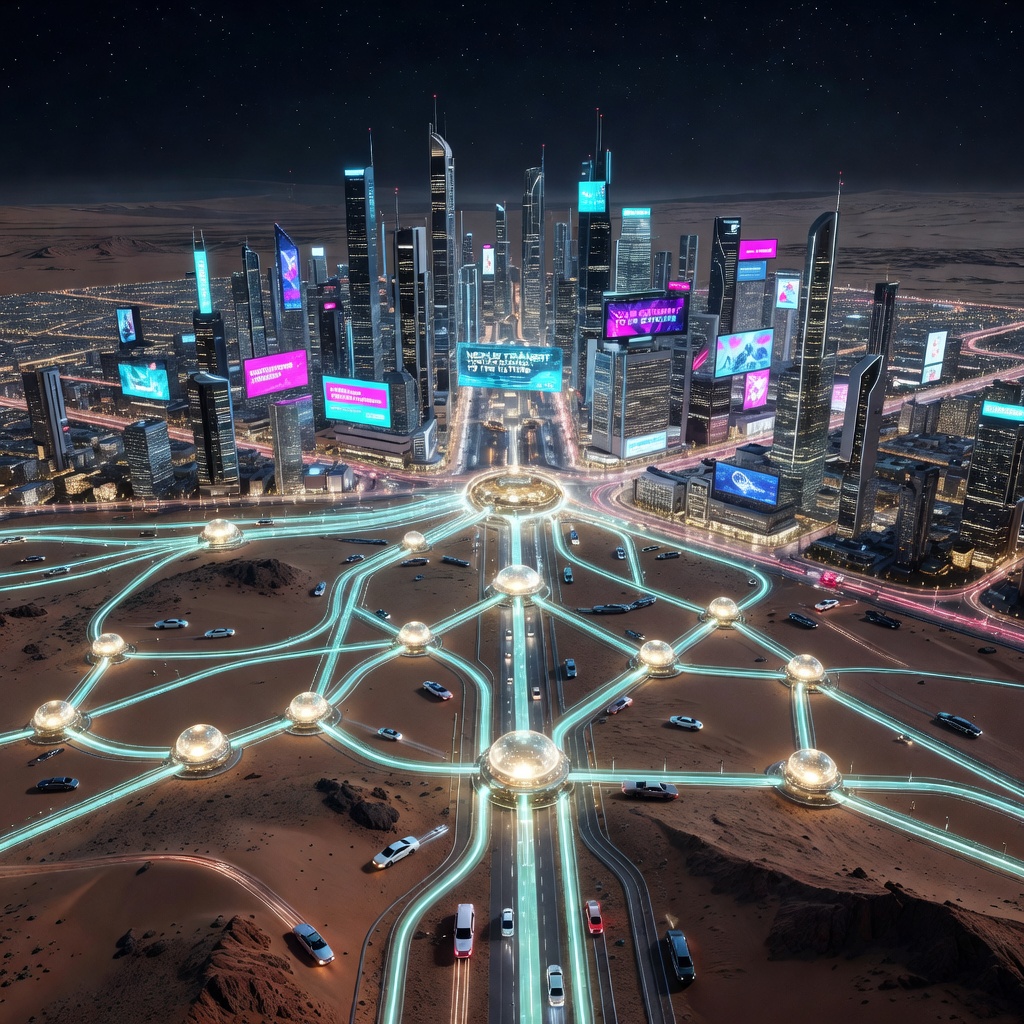
The ambition has grown in proportion to the operational track record. The full Vegas Loop, when completed, envisions connecting dozens of casino resorts, the Harry Reid International Airport, the new Allegiant Stadium, and several major convention sites through an interconnected web of tunnels. Approved extensions continue to add miles and stations to the network, making it by far the largest privately developed urban tunnel system in American history.
Beyond Las Vegas, The Boring Company has held conversations with municipalities including Fort Lauderdale, San Antonio, and several international cities. Each negotiation carries the same underlying pitch: underground capacity that avoids the surface-level political friction of tearing up existing streets, delivered at a cost structure that has been empirically refined through years of operational iteration rather than projected from a whiteboard.
The most underappreciated dimension of this journey may be the organizational one. The Boring Company has functioned less like a traditional infrastructure contractor and more like a product company that happens to be manufacturing tunnels. Product companies iterate. They ship imperfect versions, gather real-world data, and revise. Applied to civil infrastructure, a domain historically allergic to experimentation, this methodology has been both disruptive and occasionally controversial. Critics who expected a fully formed transit revolution by 2020 missed the nature of the enterprise entirely.
What the Dirt Has Taught
Every failed seal, every resonant frequency complaint, every loading-bottleneck study, and every abandoned hyperloop schematic has contributed to a system that, whatever its current limitations, demonstrably moves people underground in a commercial American city. That is not nothing. It is, in fact, precisely what the gridlock-stricken tweet from 2016 was reaching toward, a tangible alternative to the paralysis of surface transportation, built not through a single stroke of genius but through the patient, expensive, sometimes embarrassing process of learning what works by discovering what does not.
The dirt has been extraordinarily instructive. The tunnels keep getting longer.