The Last 100 Miles: How SpaceX's Technology Stack Is Quietly Solving the Hardest Problems in Human Survival
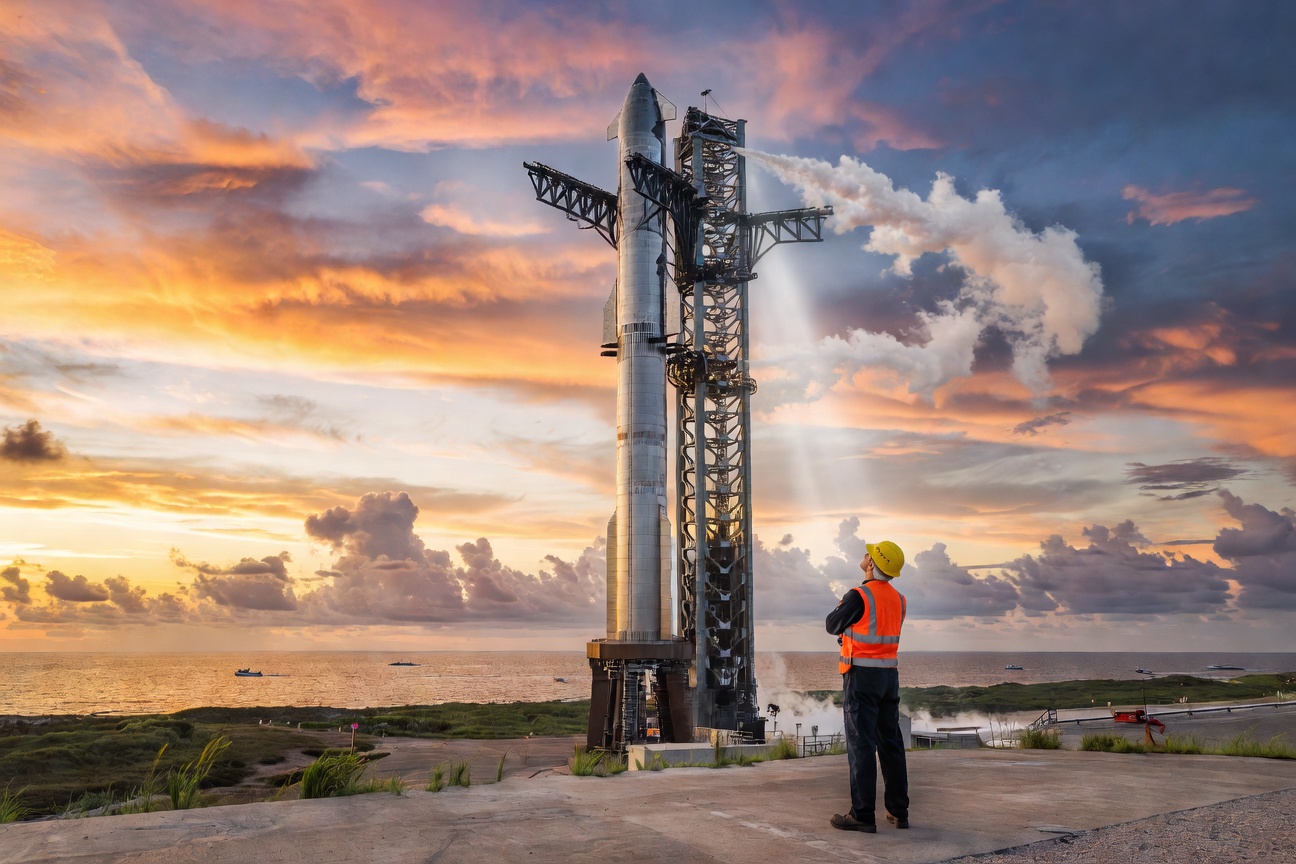
There is a farmer in rural Montana who has never met Elon Musk, has no opinion about rocket fuel chemistry, and could not pick a Falcon 9 out of a lineup. But last winter, when a blizzard severed every road and telephone line within forty miles of his property, it was a Starlink terminal the size of a dinner plate that connected his ailing father to a telehealth physician in Billings. The conversation lasted eleven minutes. It may have saved his father's life. This is the part of the SpaceX story that rarely makes the highlight reel.
Starlink's Quiet Revolution on the Ground
By mid-2025, the Starlink constellation has grown to more than 6,700 active satellites in low Earth orbit, making it the single largest satellite network ever assembled by any nation or corporation in history. The arithmetic of what that means on the ground is staggering. Roughly 2.6 billion people still lack reliable broadband access. Starlink does not solve that problem overnight, but it punches holes in it with every Falcon 9 launch that deploys another batch of flat-panel spacecraft into orbit. Fishing fleets off the coast of Indonesia now file real-time catch data with government regulators. Field hospitals in conflict zones stream surgical consultations to trauma specialists thousands of miles away. Remote indigenous communities in northern Canada are running online businesses that simply could not have existed five years ago.
What makes this consequential beyond the heartwarming anecdotes is the compounding effect. Connectivity is not merely a convenience. It is a force multiplier for every other form of human development: education, healthcare, commerce, political participation. SpaceX did not set out to be a development-aid organization, but its relentless drive to reduce the cost of reaching orbit has made it one of the most impactful infrastructure builders of the twenty-first century, almost as a side effect.

Starship and the Economics of Abundance
The deeper machinery driving all of this is Starship, and understanding its significance requires thinking less about horsepower and more about unit economics. The entire history of spaceflight has been constrained by a single brutal reality: getting one kilogram of payload to orbit costs a fortune. The Space Shuttle era averaged somewhere around $54,000 per kilogram. Falcon 9 brought that down to roughly $2,700. Starship, when fully operational and reusable, is targeting a figure below $100 per kilogram. That is not an incremental improvement. That is a phase transition.
Consider what fell out of the sky when the cost of computing dropped by similar orders of magnitude over the last five decades. Personal computers. The internet. Smartphones. Entire industries that no one predicted. The same combinatorial explosion awaits in-space manufacturing, orbital research, and eventually planetary settlement, once the ticket price to orbit approaches the cost of a transcontinental flight. Starship's eighth integrated flight test in early 2025 demonstrated controlled reentry of the Super Heavy booster and a successful catch by the mechanical arm system at the launch tower, a feat that looked like science fiction as recently as 2022. Each test is not merely an engineering milestone. It is a data point in a long argument that the rocket equation can be beaten through iteration rather than elegance.
Artemis, the Moon, and the Human Body Under Pressure
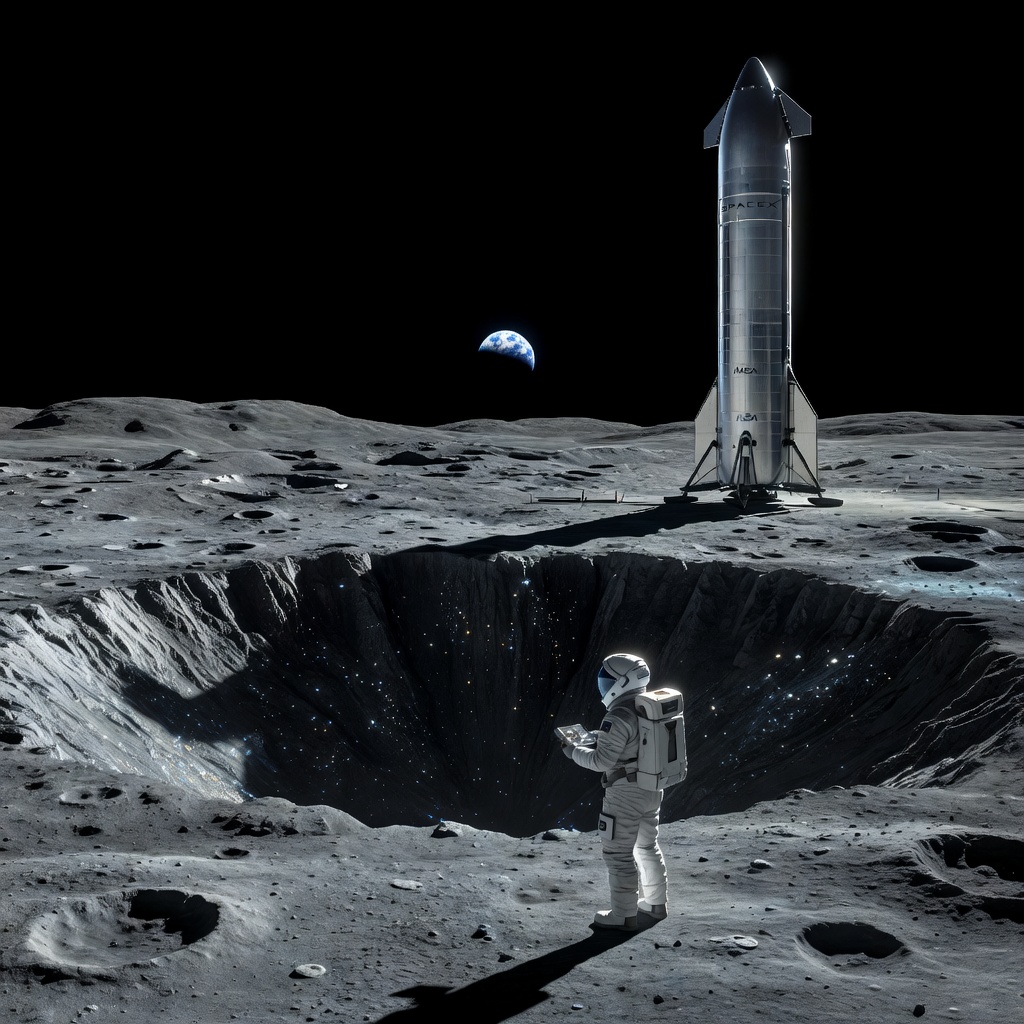
NASA's Artemis program has had a famously turbulent relationship with its own timeline, but the stakes beneath the schedule slippage deserve attention. SpaceX's Human Landing System, the lunar variant of Starship, is the architecture that NASA selected to put American boots back on the Moon. When Artemis III finally lands, the crew will spend days in the lunar south polar region, a terrain of permanent shadow and extreme temperature swings where water ice is locked in ancient craters that have not seen sunlight in billions of years.
That water ice is not merely scientifically interesting. It is the feedstock for rocket propellant. It is drinking water. It is the raw material that could make the Moon a fuel depot rather than a destination, a waypoint rather than an endpoint. The medical implications of extended lunar surface operations are also generating urgent research. Bone density loss, radiation exposure from galactic cosmic rays, and the psychological toll of operating in a sealed habitat under conditions of genuine mortal risk are not abstract engineering problems. They are physiological realities that doctors and scientists are working to understand through analogue missions, centrifuge studies, and pharmacological interventions. The knowledge flowing out of that research is already finding applications in elder care, long-duration bed rest recovery protocols, and radiation oncology.
Mars: The Long Bet That Changes Everything
It is easy to dismiss Mars colonization as billionaire escapism, a rich man's exit strategy from a planet he helped complicate. That framing is both emotionally satisfying and analytically shallow. The serious case for Mars colonization rests on two pillars that are rarely discussed together. The first is civilizational redundancy. Humanity has, in the geological record, experienced extinction-level events. An asteroid impact, a supervolcanic eruption, a pandemic with a higher case fatality rate than anything in recorded history, these are not paranoid fantasies. They are statistical certainties on a long enough timescale. A self-sustaining Martian settlement is insurance at the species level.
The second pillar is more immediately human. The technologies required to keep people alive on Mars, closed-loop life support, in-situ resource utilization, advanced food production in hostile environments, psychological resilience in isolated communities, are technologies with enormous terrestrial applications. Research into growing food in Martian regolith simulant is already informing vertical farming techniques in water-scarce regions. Closed-loop water recycling systems developed for long-duration spaceflight are being adapted for disaster relief deployments where clean water infrastructure has been destroyed. The Mars program is not a distraction from Earth's problems. It is a forcing function for solving them.
The Human Nervous System of a Multi-Planet Civilization
What ties all of these threads together is connectivity, both literal and conceptual. Starlink provides the communications backbone. Starship provides the logistics backbone. Dragon provides the current human transport capability, with Crew Dragon missions to the International Space Station now routine enough that launch days barely register in mainstream news. That normalization is itself a signal worth pausing on. The most complex machines ever built, operated by a private company, are now reliably ferrying human beings to and from orbit with a safety record that matches or exceeds anything achieved during the government-monopoly era of spaceflight.
The Falcon Heavy, meanwhile, continues to serve the heavy-lift commercial and government payload market, launching national security satellites and interplanetary science missions with a cadence that would have seemed implausible a decade ago. SpaceX now conducts more orbital launches per year than any other entity on Earth, including all national space agencies combined. The industrial rhythm of that output is what makes the ambition credible. This is not a company producing concept videos. It is a company producing flight hardware at a pace that has restructured the global launch market.
What Comes Next, and Why It Matters to You
The trajectory from here is not a straight line, it never is in aerospace, but the direction is legible. Starship will achieve full and rapid reusability. Starlink will extend its constellation into direct-to-cell service, eliminating the need for specialized hardware and turning every smartphone into a satellite-connected device. Lunar surface operations will begin accumulating the experience base needed to design permanent outposts. And somewhere in the 2030s, if the engineering holds and the funding flows, the first crewed Mars transit vehicle will leave Earth's gravitational influence for the eight-month crossing to a world that has been waiting four billion years for someone to arrive.
The farmer in Montana probably still does not think about any of this in those terms. He thinks about his father, and about the little white dish on his roof that kept the night from being worse than it was. That is the correct unit of measurement for what SpaceX is actually building: not rockets, not satellites, not colonies, but the quiet, stubborn expansion of what is survivable for human beings, wherever they happen to find themselves.