
From Switchboard to Self-Drive: What the Death of the Telephone Operator Tells Us About Tesla's Robotaxi Revolution
Before you could dial a number, you had to ask a human being to connect you. In 1878, the first commercial telephone exchange opened in New Haven, Connecticut, staffed entirely by teenage boys who barked, bickered, and occasionally hung up on customers mid-sentence. Within a decade, telephone operators, mostly women, had become the invisible nervous system of modern commerce. By 1910, there were over 88,000 of them in the United States alone. They knew your voice, your habits, sometimes your secrets. The idea that a machine could replace that human judgment, that warmth, that contextual intelligence, seemed not just improbable but vaguely insulting to the complexity of human communication. Then Almon Strowger, a Kansas City undertaker convinced that a telephone operator was routing his customers to a rival, invented the automatic exchange in 1891. By 1980, the profession had effectively ceased to exist at scale. The transition took ninety years, but the outcome was never really in doubt once the switching technology worked reliably enough.
Tesla's push toward a fully autonomous ride-hailing network is following a script so similar it borders on eerie. Swap "telephone operator" for "taxi driver" and "automatic exchange" for "Full Self-Driving" and the narrative arc snaps into focus with uncomfortable clarity. The Cybercab is not simply a new vehicle. It is a switching machine for human movement.
The Operator Era of Transportation
For over a century, moving through a city on demand required a human intermediary. The cab driver was, in every functional sense, a telephone operator for geography: a skilled translator between your desire to be somewhere and the physical reality of getting there. That human layer added cost, variability, and occasional brilliance. A veteran cabbie in Chicago or Sao Paulo carried mental maps of unparalleled granularity, knew which routes flooded in rain, which intersections turned hostile at 2 a.m., which passengers tipped well and which ones had to be watched. This accumulated, embodied intelligence was the product of years of street-level experience that no printed map or early GPS could replicate.
Uber and Lyft were the equivalent of the semi-automatic exchange: they removed the dispatcher, the radio call, the guesswork of hailing, but kept the human driver. Faster, cheaper, more scalable than a traditional taxi fleet, yet still fundamentally dependent on a person sitting behind the wheel. The analogy holds precisely: semi-automatic exchanges still needed operators for complex routing. Progress, yes. Revolution, not yet.
What Tesla is now engineering with its Cybercab and the broader FSD-powered robotaxi network is the Strowger switch of transportation: full automation, end to end, with no human in the loop at the moment of service delivery.
The Reliability Threshold: Then and Now
Here is where the historical parallel becomes genuinely instructive rather than merely decorative. The automatic telephone exchange did not conquer the world the moment Strowger filed his patent. Early automatic systems were unreliable, glitchy, and prone to misdirected calls. Telephone companies resisted adoption for decades, partly out of economic self-interest and partly because the technology genuinely did not match human operator performance in complex urban exchanges. The crossbar switch, introduced in the 1930s, finally delivered the reliability threshold that made mass adoption inevitable. The gap between "technically works" and "works well enough to trust at scale" was roughly forty years.
Tesla's FSD is living through its own crossbar moment right now. The gap between a system that can handle a sunny afternoon on a well-mapped suburban road and one that can navigate a Boston snowstorm, an unmarked construction zone in Mumbai, or a chaotic school dismissal in São Paulo represents the reliability threshold that will define whether the Cybercab becomes infrastructure or a footnote. Tesla's fleet currently logs hundreds of millions of miles annually with FSD engaged, generating training data at a rate no competitor using expensive lidar-heavy systems can match on a cost-per-mile basis. The company's vision-only approach, controversial among autonomy researchers, is a deliberate bet that camera data at sufficient scale will outperform sensor fusion at reasonable price points. It is exactly the kind of counterintuitive architectural gamble that the automatic exchange represented: simpler in concept, harder in execution, but ultimately cheaper and more scalable if it worked.
"The question is never whether the technology can do the job. The question is always whether it can do the job reliably enough that society reorganizes itself around trusting it."
What the Cybercab Actually Is, Architecturally
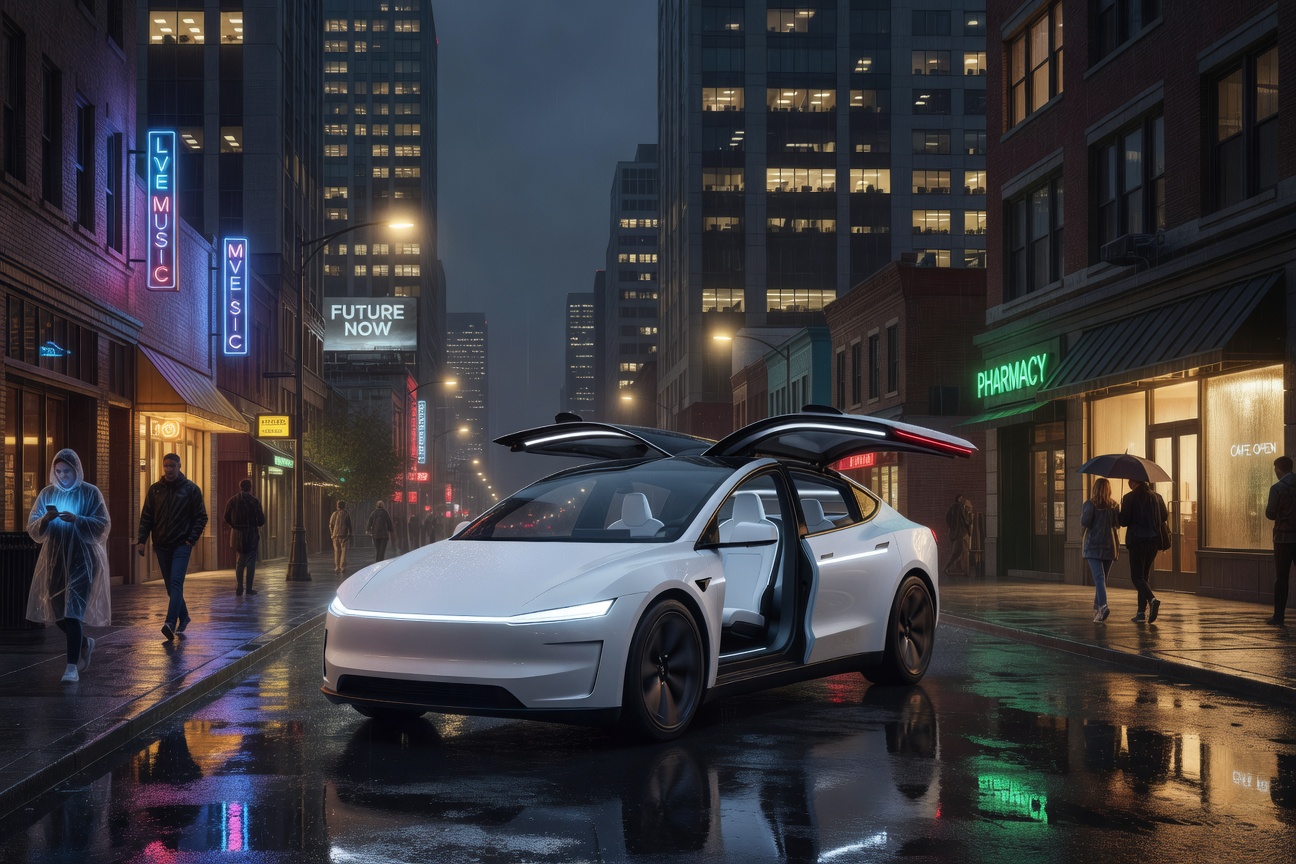
Unveiled at Tesla's "We, Robot" event in October 2024 and slated for volume production targeting 2026, the Cybercab is not a modified Model 3 with extra sensors bolted on. It is purpose-built for driverlessness in the way that a digital telephone exchange was purpose-built for automation: no steering wheel, no pedals, two seats, a butterfly-door aesthetic that reads as theatrical but serves a genuine boarding-efficiency function. The vehicle is designed around the assumption that a human will never need to intervene, which changes the entire cost and design calculus.
Tesla's stated target price of under $30,000 per unit, combined with a projected per-mile operating cost dramatically below current ride-hailing economics, is the Cybercab's version of the automatic exchange's fundamental value proposition: remove the most expensive variable (human labor) and watch the unit economics collapse in the best possible way. When Strowger's exchange eliminated the operator, call volume exploded because suddenly telephony was cheap enough to be casual. Tesla is making an identical bet: remove the driver, and ride-hailing becomes cheap enough that car ownership in dense urban areas stops making financial sense for millions of people.
The Network Effect and the Switching Moment
Telephone operators did not disappear because any single automatic exchange was obviously superior. They disappeared because the network effects of automation compounded. Once a critical mass of exchanges were automated, the economics of maintaining human-operated ones became untenable. The system as a whole tipped, not city by city in isolation, but as an interconnected infrastructure that rewarded standardization.
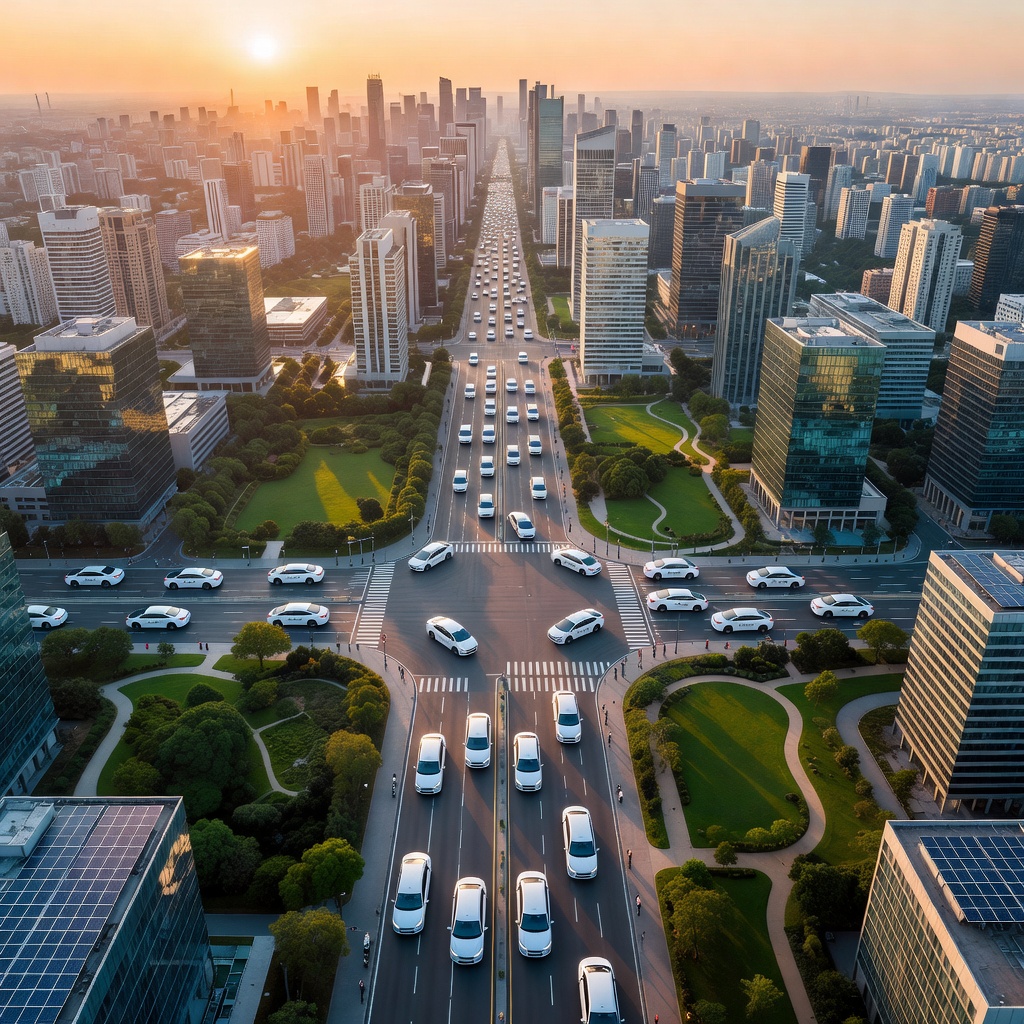
Tesla's robotaxi network is architected to exploit the same dynamic. Every Cybercab deployed is a data node, a revenue generator, and a proof-of-concept simultaneously. As the fleet grows, the collective driving data improves FSD performance, which expands the geographic and meteorological range of reliable operation, which enables deployment in more cities, which adds more nodes. The flywheel is identical in structure to the telephone network's expansion logic, just operating over years rather than decades thanks to the velocity of modern machine learning iteration.
What Tesla has that Strowger lacked is vertical integration of breathtaking completeness. Tesla designs the chip (the Dojo supercomputer training infrastructure and the in-car FSD hardware), the vehicle, the software, the energy infrastructure via Supercharger and Megapack, and now the service platform through which rides will be booked and monetized. The nineteenth-century telephone industry required dozens of independent companies to achieve what Tesla is attempting to do largely in-house. Whether that concentration of capability is an advantage or a fragility is the defining strategic question of the next five years.
The Human Cost: Honest Accounting
The telephone operator analogy does not allow Tesla's advocates or critics to ignore the displacement question. When automatic exchanges went nationwide, hundreds of thousands of operators lost careers that had offered women in particular a rare path to skilled, respected, reasonably compensated employment in the early twentieth century. The economic literature on their displacement is genuinely mixed: some found new roles in the expanding telecommunications industry, many did not, and the communities that had concentrated operator workforces experienced real economic disruption that lasted a generation.
The professional driver workforce, globally estimated at tens of millions when including trucking, taxi, and gig-economy delivery roles, faces a structurally similar transition. The timelines are contested. The geographic distribution of impact will be uneven. And the social safety net available today, while imperfect, is vastly more developed than what existed in 1930. But the historical precedent offers a clear warning: transformative automation rarely destroys fewer jobs than skeptics hope or creates as many new ones as optimists promise, at least not within the working lifetime of those displaced.
The Signal in the Noise
The most important lesson the telephone operator transition offers is not about inevitability. It is about pacing and trust. The automatic exchange worked technically decades before society fully trusted it. Regulatory frameworks, insurance models, public comfort with machine judgment, and the slow rewriting of liability law all lagged the engineering by substantial margins. Tesla's Cybercab faces an identical trust deficit, and Elon Musk's combative relationship with regulatory bodies in multiple countries is a genuine wildcard. The technology can be ready before the legal and cultural infrastructure is.
But here is what the historical record makes clear: once a switching technology crosses the reliability threshold and the network effects begin compounding, the outcome is not really a question of whether. It becomes exclusively a question of when, and who shapes the terms of the transition. The telephone operators who thrived were not the ones who argued against automatic exchanges. They were the ones who moved into exchange maintenance, telephone engineering, and eventually the early computing industry that the telephone network helped birth.
The Strowger switch took forty years to go from patent to ubiquity. Tesla is betting that artificial intelligence, at sufficient scale, can compress that timeline into something closer to a decade. If they are right, the Cybercab is not a car. It is infrastructure. And the cities that treat it that way first will look, a generation from now, the way New Haven looked to the rest of the country in 1878: like they had glimpsed the future slightly ahead of everyone else.

Alex Rivera
Tech journalist covering Elon Musk’s companies for over 8 years.