One Interface, Seven Billion Realities: How the World Is Splitting Over Brain-Computer Technology

Picture a single microchip, roughly the diameter of a shirt button, capable of reading and writing electrical signals directly from living human neurons. In San Francisco, venture capitalists argue over its valuation at rooftop dinners. In Beijing, state engineers are quietly building a domestic version with no foreign intellectual property attached. In Lagos, a neurosurgeon who trained in London weighs whether her hospital will see this device in her career lifetime. And in a small village in rural Rajasthan, a farmer with a spinal cord injury has never heard the words "brain-computer interface" spoken aloud, yet he is precisely the person its inventors claim they are trying to help. The technology is singular. The world receiving it is not.
The Valley Builds It, But Who Gets to Use It?
Neuralink, Elon Musk's neurotechnology company, has become the most visible symbol of the BCI era. With its first human implant recipients demonstrating control of computer cursors and digital devices using thought alone, the company has shifted the conversation from speculative science fiction to regulatory filings and clinical trial enrollment. The ambition is explicit and enormous: Musk has spoken of a future where humans and artificial intelligence merge seamlessly through neural bandwidth, preserving human agency in a world increasingly dominated by machine cognition.
But the pipeline from Fremont clean rooms to global patients is not a smooth highway. It is a fractured, politically loaded, culturally negotiated obstacle course. And the first fault line appears almost immediately: the regulatory one.
In the United States and Western Europe, BCI devices face rigorous multi-phase clinical trial requirements. The FDA's Breakthrough Device designation, which Neuralink holds, accelerates but does not simplify the approval pathway. Competing companies like Synchron, whose stentrode device threads through blood vessels rather than requiring open-brain surgery, are navigating similar terrain. The regulatory architecture in these jurisdictions is designed around individual patient rights, informed consent, and long-term safety data. It is slow by design, and that slowness has a geographic consequence: the first wave of patients accessing these devices will overwhelmingly be wealthy, insured, and located in countries with advanced hospital infrastructure.
China's Parallel Track
While Western companies navigate ethics boards and congressional hearings, China is executing a state-coordinated BCI strategy that operates on an entirely different logic. The country's 14th Five-Year Plan explicitly identified brain science and brain-inspired computing as national priorities. Institutions like the Beijing Institute of Brain Science are not startup competitors to Neuralink; they are instruments of strategic policy with access to patient populations, funding streams, and data-sharing frameworks unavailable to private Western firms.

Chinese researchers published over 40,000 neuroscience papers in a recent five-year window, a volume that has begun to rival American output. Domestic BCI companies like BrainCo and NeuraMatrix are developing non-invasive and minimally invasive devices tailored not just to medical applications but to education and workplace productivity monitoring. The cultural framing is strikingly different from the West: where American BCI discourse emphasizes individual empowerment and personal enhancement, Chinese state media tends to frame the same technology through collective productivity and national capability. These are not trivial semantic differences. They shape which applications get funded, which patients get enrolled, and which data gets collected and by whom.
The geopolitical stakes are significant enough that several U.S. senators have already raised concerns about neural data harvesting and the possibility that consumer-grade BCI devices manufactured in China could transmit sensitive cognitive and biometric information across borders. The brain, it turns out, is the ultimate data sovereignty battleground.
The Global South's Unsimple Equation
Strip away the superpower competition and a harder, quieter story emerges. Neurological conditions do not respect economic geography. Stroke is the second leading cause of death globally, and the burden falls disproportionately on low- and middle-income countries. Spinal cord injuries, traumatic brain injuries, and treatment-resistant epilepsy affect millions of people in regions where a basic MRI machine is a logistical achievement, let alone a surgical robot and a team of neurosurgeons trained to implant a millimeter-precision electrode array.
The honest arithmetic is brutal. A Neuralink implant procedure, even after the technology matures and cost curves bend downward, is projected to remain a high-resource intervention for the foreseeable future. It requires pre-surgical imaging, a specialized robot for implantation, post-operative monitoring, wireless charging infrastructure, and software ecosystems that demand reliable internet connectivity. For the 800 million people living without consistent electricity access, this technology tree has roots that simply do not reach their soil.
Some researchers argue this framing is too pessimistic. Non-invasive BCI devices, including EEG-based headsets that read surface brain activity without surgery, are already available at consumer price points. Organizations working in rehabilitation medicine across Southeast Asia and parts of Africa are experimenting with these lower-fidelity tools for stroke recovery and communication assistance. The gap between a consumer EEG headset and a Neuralink N1 chip is enormous in terms of signal quality and capability, but the non-invasive tier at least represents a foothold.
Cultural Consent: When the Brain Meets Belief
Beyond infrastructure and cost, there is a dimension of the global BCI map that engineering roadmaps rarely capture: the extraordinary variation in how different cultures conceptualize the brain, the self, and the sanctity of mental privacy.
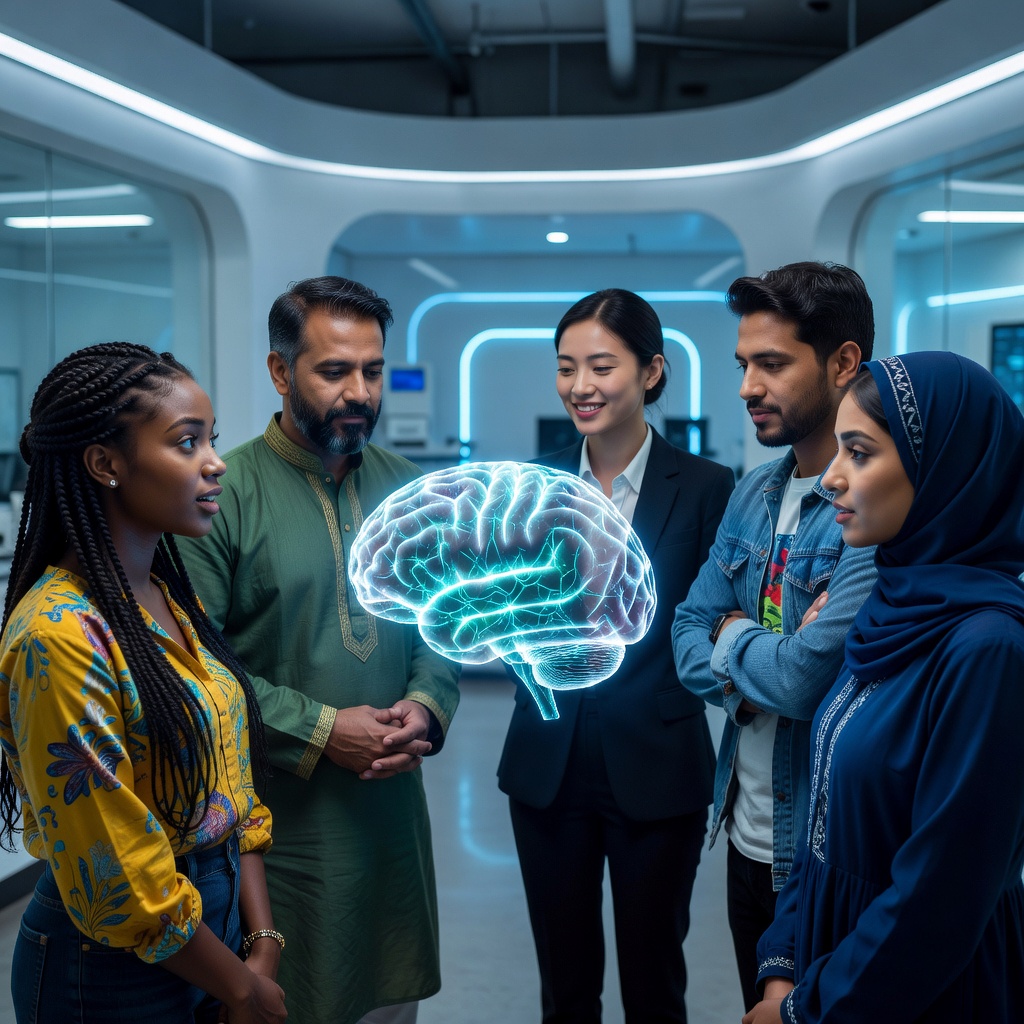
In Japan, where robotics and assistive technology have long been woven into eldercare culture with relatively high social acceptance, early surveys on BCI willingness show measurably different responses than equivalent surveys conducted in Germany or Brazil. In many Indigenous communities across the Americas and Oceania, the very premise of a device that reads neural signals raises immediate sovereignty concerns tied to broader histories of bodily autonomy being overridden by outside institutions. Several First Nations advocacy groups in Canada have already begun publishing position papers on neurotechnology governance, arguing that existing bioethics frameworks are too individualistic and fail to account for collective community consent.
In predominantly Muslim-majority nations, Islamic bioethics scholars are actively debating whether cognitive enhancement crosses a line separating therapeutic correction of disability from impermissible alteration of human nature as created by God. The debates are nuanced and far from settled, but they matter enormously for adoption trajectories in countries that collectively represent hundreds of millions of potential future patients or customers, depending on which word you prefer.
Musk's Global Gamble
Elon Musk has never been shy about the civilizational scale of his ambitions. His stated rationale for Neuralink goes beyond helping paralyzed patients type: it is about ensuring that biological humans can keep pace with artificial general intelligence and avoid what he has repeatedly characterized as the existential risk of cognitive obsolescence. That framing plays well in certain technology communities and rather poorly in others.
In practice, Neuralink is currently a medical device company seeking FDA approval for specific neurological indications. But the infrastructure it is building, including the surgical robot, the wireless chip architecture, the cloud-connected neural data pipeline, will define the substrate on which future enhancement applications could eventually run. The medical use case is the beachhead. The territory behind it is vast and contested.
What the global picture reveals is that the BCI revolution, like every transformative technology before it, will not arrive uniformly. It will be filtered through the prisms of local regulation, national strategy, economic capacity, cultural belief, and political will. The result will not be a single future in which all of humanity upgrades in parallel. It will be a jagged, uneven, deeply human patchwork, where some people gain capabilities that others cannot access, and where the meaning of those capabilities shifts depending entirely on context.
The Question Nobody Has Answered
There is a question that sits underneath all of this geopolitical and cultural analysis, one that the most technically sophisticated BCI researchers tend to deflect and that policymakers have not yet found language to address: when a technology can read and eventually write to human thought, who owns the governance architecture that determines its terms of access?
International bodies like the WHO and UNESCO have begun publishing frameworks on neurotechnology ethics, but frameworks are not enforcement mechanisms. The ITU governs radio frequency spectrum. The IAEA governs nuclear material. There is no equivalent institution for neural data, and building one requires a level of global cooperation that the current geopolitical climate makes extremely difficult.
What is clear is that the next decade will not simply be a story about a remarkable chip and the patients it helps. It will be a story about whether humanity can build governance fast enough to catch the technology, and whether that governance will reflect the full diversity of the world that neurotechnology claims to serve. The interface may be universal. The question of who controls it is anything but.