The Methodology Wars: How Competing Research Agendas Are Shaping What We Think We Know About Underground Transit
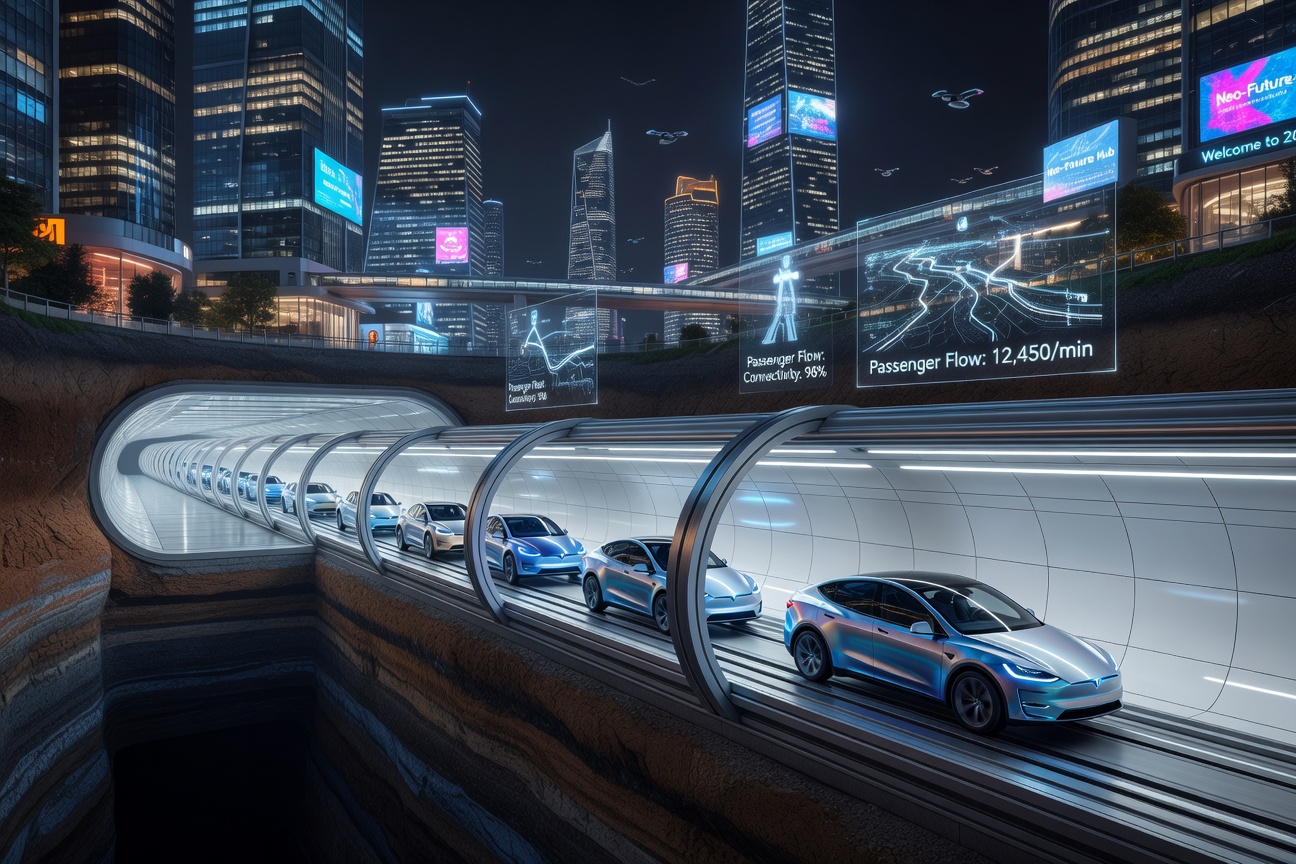
Picture two researchers, both credentialed, both published, both citing the same 1.4-mile Las Vegas Convention Center Loop as their primary data source. One concludes that The Boring Company's underground transit model is a transformative leap in urban mobility. The other concludes it is a glorified parking garage with ambitions too large for its lane. Neither is lying. Both, however, have something to gain. Welcome to the methodology wars quietly reshaping what the public, city planners, and elected officials believe about underground transit.
The Vegas Loop, now operating across several miles beneath the Las Vegas Strip with expansion contracts extending the network toward the airport and beyond, has become something it was never formally designed to be: a living laboratory whose outputs are being selectively harvested by researchers, consultants, and think tanks to advance agendas that often have very little to do with getting commuters from point A to point B efficiently.
The Benchmark Problem Nobody Wants to Solve
At the core of the dispute is a deceptively simple question: what should underground transit be measured against? Traditional subway systems? Autonomous bus rapid transit? Surface-level light rail? The answer to that framing question determines almost every downstream conclusion, and yet there is no agreed-upon standard. Researchers aligned with municipal transit authorities tend to benchmark the Vegas Loop against legacy rail systems, producing comparisons that highlight its lower per-vehicle capacity and dependence on human drivers during current operational phases. Researchers funded by or affiliated with private mobility companies, real estate developers, or technology investors tend to benchmark it against traffic congestion and surface-level rideshare alternatives, producing results that make tunneling look like an obvious winner.
This benchmark selection is not a minor methodological footnote. It is the entire ballgame. A system moving 1,400 passengers per hour in a constrained Vegas corridor looks modest when compared against a metro line capable of moving 30,000 per hour. The same system looks revolutionary when compared against the 40-minute surface drive it replaces at peak conference hours. Both comparisons are technically accurate. Neither is complete.
"The moment you choose your benchmark, you have already written most of your conclusion. Everything after that is arithmetic."
Follow the Grant, Find the Conclusion
An examination of publicly available research funding disclosures from 2021 through 2024 reveals a striking pattern. Studies producing favorable assessments of tunnel-based private transit tend to carry funding from one of three source categories: venture capital-adjacent research foundations with undisclosed limited partner structures, real estate investment groups with active holdings in cities where tunnel contracts are pending, or direct consulting relationships with The Boring Company or its municipal partners.
This does not make the research fraudulent. Conflicts of interest exist across the entire academic and consulting landscape, including on the skeptical side, where legacy transit unions, competing infrastructure contractors, and public transit advocacy groups with specific funding interests have also commissioned research reaching predictably critical conclusions. The problem is that city councils in Austin, San Diego, Fort Lauderdale, and a dozen other municipalities are making billion-dollar infrastructure commitments while treating these studies as independent assessments rather than advocacy documents wearing academic clothing.

The Vegas Loop's operational data, which The Boring Company controls and releases selectively, sits at the center of this ecosystem. Detailed throughput figures, vehicle utilization rates, maintenance cost breakdowns, and failure incident reports are not publicly available in the granular form that independent researchers would need for rigorous analysis. What gets released are aggregate ridership numbers and curated passenger experience metrics, the kind of data that answers the question "was the ride pleasant?" rather than "does this scale to a city of two million people at a cost taxpayers can sustain?"
The Scaling Dispute That Will Not Stay Buried
Perhaps no methodological disagreement carries higher stakes than the scaling debate. The Boring Company's value proposition has always rested on a future state: a network of tunnels dense enough to function as a genuine transit alternative, with autonomous vehicles eventually replacing the current human-driven Tesla fleet and dramatically increasing throughput. Proponents argue that current operational metrics are therefore the wrong measurement unit entirely, that judging a nascent network by its early-phase numbers is like judging the internet by its 1994 dial-up speeds.
Critics counter that this logic is unfalsifiable by design. If present data cannot be used to evaluate the system, and future projections rely on autonomous vehicle capabilities and tunnel boring cost reductions that have not yet materialized at promised timescales, then the entire framework becomes immune to empirical challenge. You cannot fail a test you are allowed to postpone indefinitely. This is not merely an academic grievance. Several cities have signed contracts with 20-year operational horizons, locking in financing structures whose repayment logic depends on ridership projections that have never been independently validated at the scale being promised.
The autonomous vehicle question is particularly thorny. Current Vegas Loop operations use Tesla vehicles with human drivers, a significant operational cost that future projections typically assume away. Elon Musk has consistently positioned full self-driving capability as imminent across multiple product lines, and those projections have consistently required revision. Researchers who incorporate autonomous vehicle timelines directly into tunnel transit cost models are building their analyses on a foundation that is itself contested, but the uncertainty rarely makes it into executive summaries that land on city council desks.
The Quiet Role of Real Estate in the Research Narrative
One underreported dimension of the research ecosystem is how significantly property value impact studies have shaped the political viability of tunnel transit proposals. In city after city, feasibility discussions have been accelerated or prolonged based on analyses claiming that tunnel proximity drives up commercial and residential property values. These studies, frequently commissioned by development groups with active projects near proposed tunnel routes, create a secondary political constituency for underground transit approval that has nothing to do with transit utility and everything to do with asset appreciation.

In Las Vegas itself, the expansion of the Loop toward resort properties on the Strip has tracked almost perfectly with major hospitality groups' real estate development timelines. The question of whether tunnel access drives property value or whether property developers drive tunnel routing decisions is one that the current research literature has, conspicuously, not resolved. The causal arrow matters enormously for public policy, because a transit system primarily optimizing real estate value is a fundamentally different public infrastructure investment than one optimizing mobility equity and congestion reduction.
What a Genuinely Independent Assessment Would Look Like
Several transportation researchers, speaking candidly about systemic issues they are reluctant to attach their names to publicly, have described what rigorous independent evaluation of the Vegas Loop model would actually require. Full operational data disclosure, including unfiltered incident reports, actual vehicle utilization rates per tunnel segment, real maintenance cost accounting, and honest driver labor cost attribution. Benchmark selection processes conducted before data collection begins, not after. Scaling models that treat autonomous vehicle timelines as uncertain variables with probability ranges rather than confirmed future inputs. And crucially, conflict of interest disclosures that extend beyond direct funding to include equity positions, consulting relationships, and institutional affiliations of every named author.
None of these standards are revolutionary. They are, broadly speaking, what quality scientific journals already require in other fields. The fact that they are not uniformly applied in urban transit research is a structural problem predating The Boring Company by decades. What has changed is the dollar scale of the decisions being made on the basis of this contested research, and the speed at which cities are being asked to commit.
The Stakes Are No Longer Theoretical
With The Boring Company holding active project agreements or advanced negotiations in cities representing a combined population of tens of millions, the methodology wars are no longer a dispute confined to academic corridors. They are a governance crisis in slow motion. When the research ecosystem that informs major public infrastructure decisions is structurally compromised by undisclosed incentives, contested methodologies, and selective data availability, the cities that end up underground are not just betting on a transit technology. They are betting on whose version of the truth got to the decision-makers first.
Elon Musk has never claimed that the Vegas Loop is a finished product. His public framing has consistently positioned it as iteration zero of something far larger. The problem is that the research ecosystem surrounding it has not always maintained that same honesty about its own provisional nature. And when iteration zero becomes the justification for 30-year municipal bond issuances, the difference between a prototype and a proven system stops being a philosophical distinction and starts being a financial one that taxpayers will eventually settle.
The tunnels are real. The vehicles are running. The riders, by most accounts, enjoy the experience. What remains buried is a cleaner accounting of what we actually know, what we are projecting, and who benefits from keeping those two categories blurred.