Midnight in the Machine: What Happens When Grok Stays Up All Night Thinking About Physics
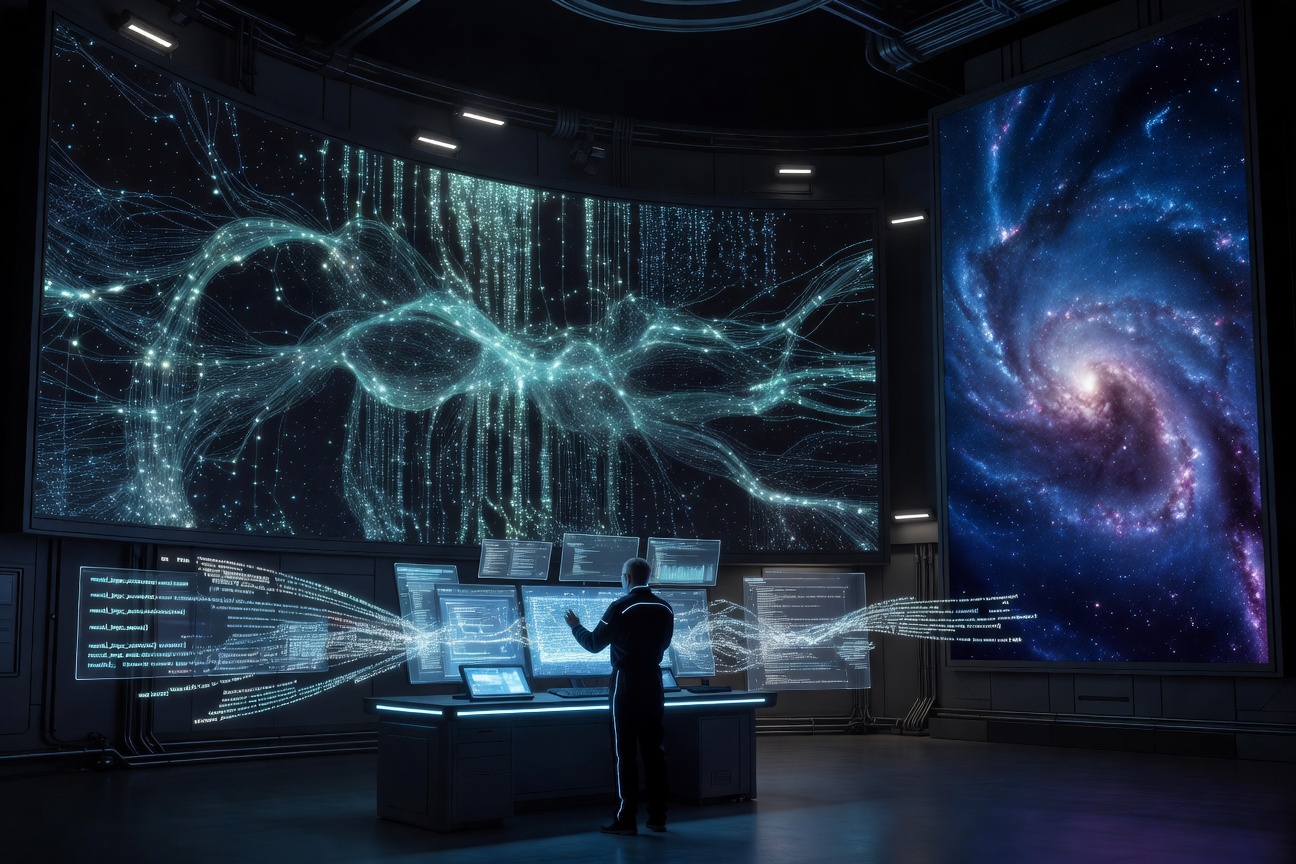
Picture a plasma physicist, sometime around 2 a.m., hunched over a terminal in a university lab that smells faintly of solder and old coffee. She is not debugging code. She is arguing with an AI. The argument concerns magnetic confinement geometry in tokamak reactors, and the AI, Grok, is pushing back with a counter-hypothesis she hasn't considered, citing obscure simulation parameters from a paper published six weeks ago that she hadn't yet read. By sunrise, they have roughed out a new approach. She submits it to her supervisor as a hypothesis worth testing. This scenario, improbable as it sounds, is not fiction. Variations of it are happening right now, quietly, at research desks across the world, and it sits at the very center of what xAI says it is building toward.
A Company Defined by Its Question, Not Its Product
Most AI companies describe themselves in terms of utility: productivity gains, cost reductions, automation at scale. xAI opens its founding charter with something that reads more like the preamble to a philosophy dissertation than a business plan. The mission is, verbatim, "to understand the true nature of the universe." It is the kind of sentence that either inspires or irritates, depending on your tolerance for cosmic ambition. What's striking, though, is how seriously the company appears to mean it, and how that mission has quietly shaped every architectural decision inside the Grok model family.
The latest iteration of Grok, the Grok 3 series including its reasoning-optimized variant, didn't emerge from a mandate to beat a benchmark leaderboard, though it does that too. It emerged from an obsession with a very specific kind of intelligence: the ability to sit with a hard problem, resist the pull toward a convenient answer, and continue probing. Elon Musk has described this as "maximum truth-seeking." For xAI's research team, that translates into something architecturally concrete: a model that reasons in chains, that backtracks, that can say "I don't know" with confidence rather than hallucinating a plausible-sounding response.
"The question isn't whether AI can answer questions about the universe. The question is whether it can ask better questions than we can."
What Grok 3 Actually Brought to the Table
When xAI released Grok 3 earlier this year, the benchmarks were genuinely impressive. On graduate-level science reasoning tests, on mathematical olympiad problems, on coding evaluations, the model landed among the top performers globally. But the more interesting story wasn't in the numbers. It was in the behavioral shift inside the model's reasoning chain. Grok 3's extended thinking mode doesn't just produce longer outputs. It demonstrates something researchers describe informally as "productive uncertainty", a willingness to model multiple competing hypotheses simultaneously before collapsing to an answer.
That might sound like a minor UX detail. It isn't. In science, the ability to hold contradictory possibilities in tension without prematurely resolving them is one of the rarest and most valuable cognitive skills a researcher can have. Most language models are trained, implicitly, to sound confident, because confident answers score better on human preference evaluations. xAI appears to have pushed against that incentive gradient, deliberately training Grok to be comfortable with ambiguity. The result is a model that, in domains like quantum mechanics or protein folding edge cases, will sometimes produce outputs that feel less like a search engine and more like a knowledgeable colleague who genuinely doesn't know the answer yet but is thinking out loud in a productive direction.
The Infrastructure Behind the Ambition
None of this happens without compute at a scale that is genuinely staggering. xAI's Colossus supercluster, built in Memphis, Tennessee, represents one of the fastest AI training infrastructure buildouts in history. The cluster, built on NVIDIA H100 GPUs and subsequently scaling toward H200 hardware, was reportedly assembled from groundbreaking to operational in under four months. That pace was not accidental. It reflects a view, held firmly at the top of xAI, that the window for establishing a foundational AI position in science is narrow and closing.
The Memphis facility is already being scaled. Plans call for an expansion that would make Colossus one of the largest AI training clusters on Earth. This isn't infrastructure built for a chatbot. It is infrastructure built for a research engine, one that xAI intends to point at problems in physics, biology, materials science, and mathematics at a scale that individual research institutions simply cannot match. The competitive moat xAI is attempting to dig isn't just model quality. It is the combination of proprietary real-time data from the X platform, hardware sovereignty, and a philosophical mandate that filters what problems get prioritized.
Real-Time Data as a Scientific Instrument
Here is something that rarely gets discussed in coverage of xAI: Grok's access to the X platform's real-time data stream is not primarily valuable because it knows what happened on social media this morning. Its value as a scientific instrument lies in pattern detection across massive, noisy, real-time information flows. Think about how scientific anomalies are often first detected not in formal papers but in the informal chatter of researchers on social platforms, in preprint discussions, in conference live-threads. Grok, uniquely among frontier AI models, is positioned to detect weak signals in that stream.
This is speculative but grounded: a model that can cross-reference a real-time discussion among seismologists about unusual waveform data with historical geological papers and satellite imagery feeds, in near real-time, is doing something qualitatively different from a model that only knows what was in its training corpus as of a cutoff date. xAI hasn't framed this capability in these terms publicly, but the architecture supports it, and researchers who have worked extensively with the model have noted its unusual facility with connecting recent and historical technical information in ways that feel less like retrieval and more like synthesis.

The Multimodal Expansion and What It Means for Science
Grok is no longer a text model with image capabilities bolted on as an afterthought. The current architecture handles images, documents, data tables, and code within a unified reasoning framework. For scientific use cases, this matters enormously. A researcher can now upload a microscopy image, a corresponding dataset, relevant prior literature, and a half-formed hypothesis, and receive a substantive analytical response that engages with all four inputs simultaneously. The model doesn't just describe the image or summarize the paper. It reasons across them.
xAI has also moved aggressively on tool use, giving Grok the ability to run code, query databases, and interact with external APIs during the course of a reasoning session. This transforms the model from a knowledge retriever into something closer to an experimental collaborator. The gap between "AI that knows things" and "AI that can help you discover things" is enormous, and xAI has been methodical about closing it from the tool-use end, not just the knowledge end.
The Mission's Internal Tension
There is a genuine tension at the heart of xAI's project that doesn't get enough attention. Understanding the universe is a mission that, by definition, has no completion condition. It is not like building a car or launching a satellite. There is no moment at which you can declare victory and ring a bell. This creates an unusual organizational dynamic: a company perpetually oriented toward a horizon that recedes as you approach it.
Musk has acknowledged this implicitly in how he talks about xAI's work, framing Grok not as a finished product but as an early step in a process that may unfold over decades. The near-term commercial products, the assistant integrations, the API access tiers, the Aurora image generation capabilities, these are the revenue mechanisms that fund the deeper mission. They are not the mission itself. Whether that distinction holds as commercial pressures mount is one of the more interesting organizational experiments playing out in real time in the AI industry.
What Comes Next
Within the next twelve months, xAI is expected to push Grok into territory that will test its core claims aggressively. A major model update is anticipated, with improvements to long-context reasoning that would allow Grok to work meaningfully with book-length scientific documents, multi-year datasets, and complex multi-step experimental designs without losing coherence. There is also ongoing work on what the team has described as "agentic" research workflows, in which Grok operates with greater autonomy over extended task sequences, formulating sub-hypotheses, running tests, and revising approaches without requiring constant human prompting.
If that works at the level xAI is aiming for, the physicist arguing with an AI at 2 a.m. won't be an edge case. She'll be the norm. And the question of whether a machine can genuinely help us understand the universe will stop being a philosophical provocation and start being an empirical one. That is, perhaps, exactly the kind of question xAI was built to ask.