
The Disengagement Equation: What Hard Failure Data Reveals About Tesla's FSD and the Cybercab's Readiness Clock
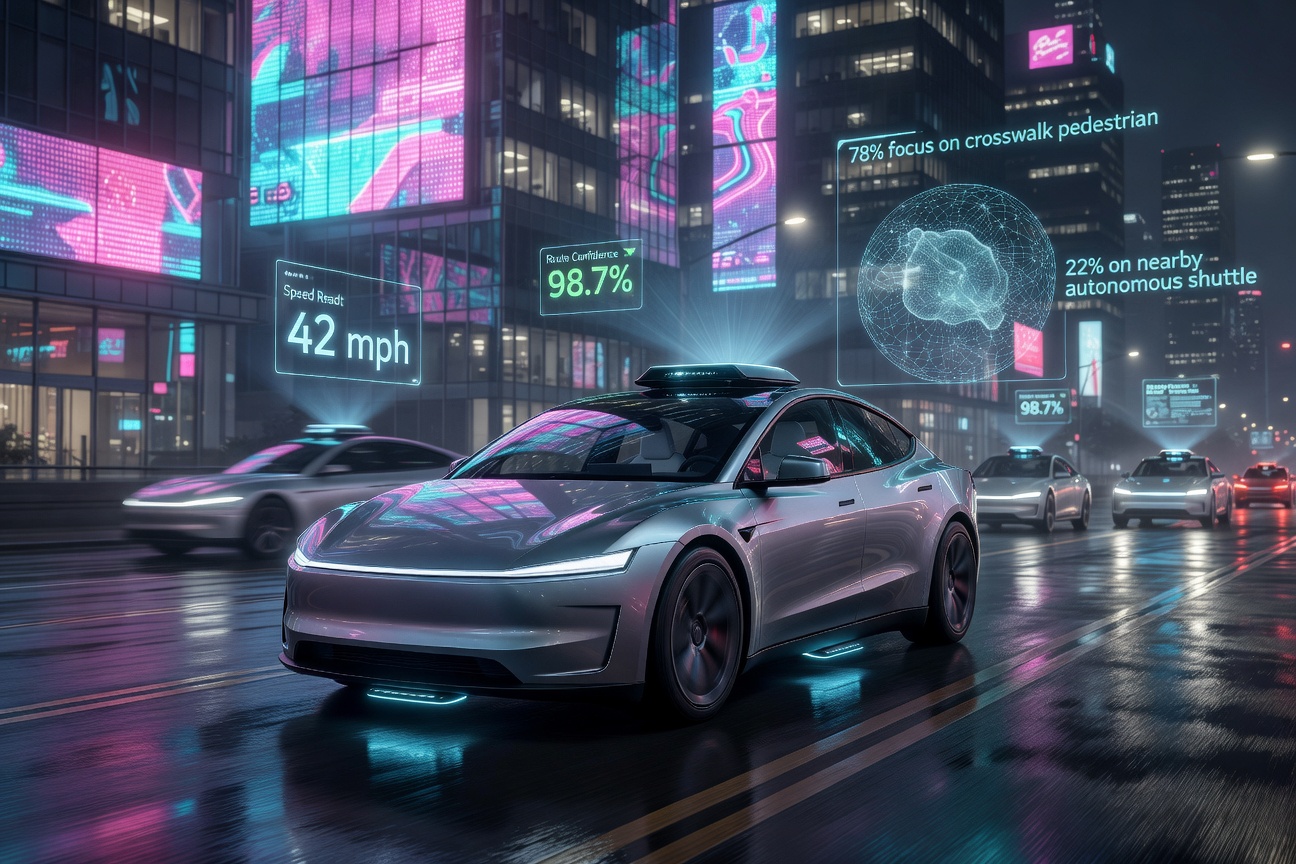
There is a measurement that haunts every autonomous vehicle program on Earth, one that regulators obsess over, investors quietly dread, and engineers argue about over cold coffee at 2 a.m. It is not range. It is not price. It is the disengagement rate: the number of times per mile a self-driving system requires a human to grab the wheel before something goes wrong. And right now, the trajectory of that single metric may tell us more about Tesla's Cybercab launch timeline than any earnings call ever could.
Defining the Measurement That Matters Most
Disengagement data has historically been the closest thing the autonomous vehicle industry has to a universal report card. California's Department of Motor Vehicles mandates that any company testing autonomous vehicles on public roads file annual disengagement reports, giving analysts a rare apples-to-almost-apples comparison. The metric captures every instance where the system either requests human override or where the safety operator intervenes preemptively. It is imperfect but indispensable.
Tesla operates differently from Waymo, Cruise, and other traditional AV developers. Rather than deploying a relatively small test fleet instrumented for regulatory reporting, Tesla has used its consumer vehicle fleet as a distributed data collection engine, gathering billions of real-world driving miles through its shadow mode and FSD beta programs. This creates a statistical asymmetry that is genuinely difficult to resolve: Tesla's dataset dwarfs competitors in raw volume, but direct disengagement-per-mile comparisons remain methodologically murky because the operational contexts differ so dramatically.
Still, what we can do is interrogate the numbers Tesla has made available, cross-reference them against third-party safety audits, and model the gap between current FSD performance and the threshold required for commercial robotaxi operation without a safety driver. That gap, it turns out, is measurable and shrinking, but it is not yet closed.
The Benchmark Ladder: What Commercial Viability Actually Requires
To contextualize Tesla's progress, you need a target. Waymo's publicly reported disengagement rate in its most recent San Francisco operational data sits at roughly one disengagement per 50,000 miles in its geofenced operational design domain. That number is extraordinary and reflects over a decade of high-definition mapping, sensor fusion with lidar and radar arrays, and an extremely conservative approach to operational domain expansion.
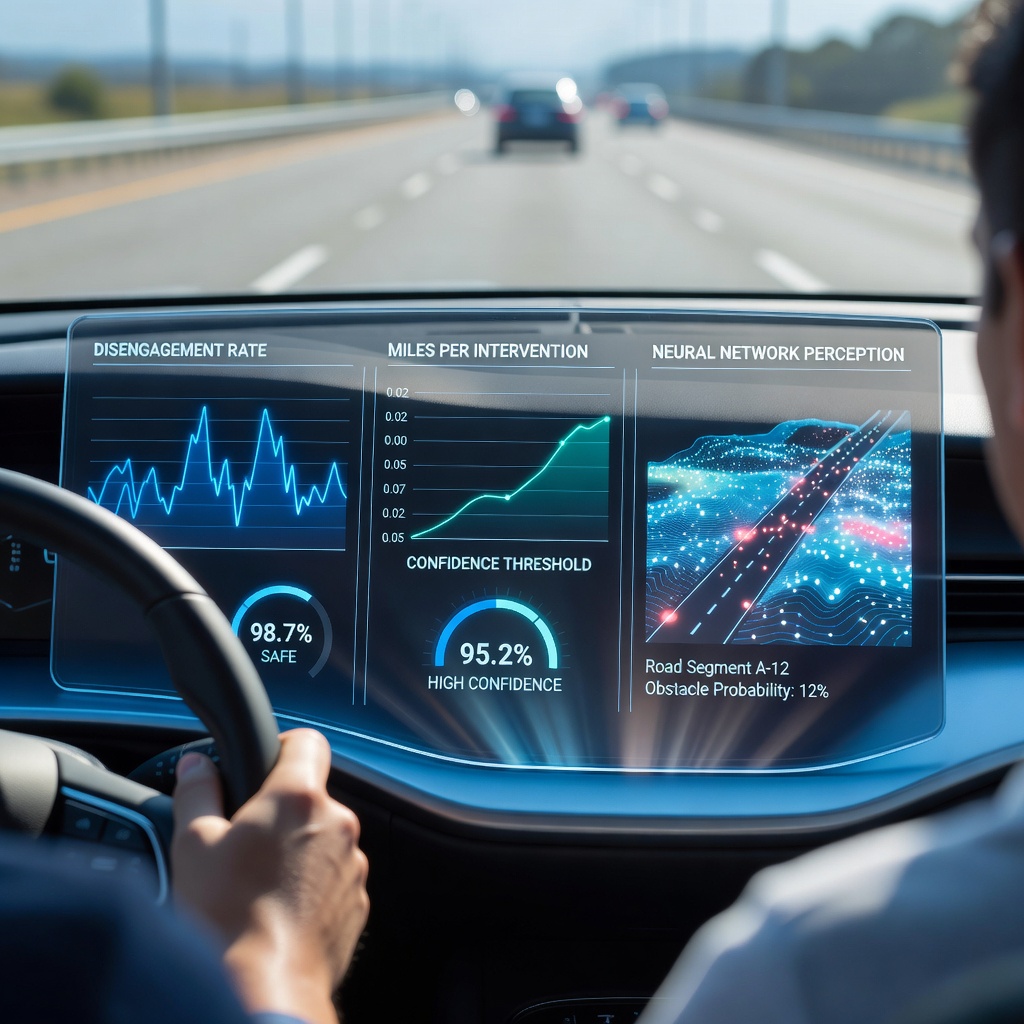
Industry analysts at firms tracking AV commercialization generally place the safety-driver-free commercial threshold somewhere between 10,000 and 100,000 miles per critical disengagement, depending heavily on the operational domain. Urban cores with dense pedestrian traffic demand the higher end of that range. Highway and suburban environments are more forgiving. Tesla's FSD Version 12, which introduced an end-to-end neural network architecture replacing the prior modular rule-based system, has been internally benchmarked by the company at intervention rates that Tesla claims are competitive with or superior to human drivers on a per-mile basis in specific route categories.
But "competitive with human drivers" and "safe for fully driverless commercial operation" are not synonymous thresholds. Human drivers cause roughly 1.35 fatalities per 100 million miles in the United States. A commercial robotaxi operator launching without safety drivers would face not just technical scrutiny but an asymmetric public relations liability: a single high-profile incident carries outsized reputational weight regardless of the statistical baseline. The real target is therefore not just matching humans but building a margin of statistical superiority large enough to absorb that narrative risk.
FSD v12's Architecture Shift and What the Data Shows
The transition from FSD v11 to v12 represented arguably the most significant architectural change in Tesla's Autopilot history. The company replaced approximately 300,000 lines of explicit C++ logic with a single imitation-learning neural network trained on video prediction from its fleet. The system now processes eight cameras simultaneously through a transformer-based architecture and outputs control signals without any intermediate rule-based layer.
The practical effect on intervention frequency has been measurable. User-reported data aggregated through the Tesla FSD community tracker, which crowdsources disengagement events per 100-mile segments across thousands of drivers, showed a roughly 40 to 60 percent reduction in critical disengagements between late v11 builds and mid-cycle v12 builds on comparable route categories. Suburban arterial roads showed the most dramatic improvement. Dense urban cores with unprotected left turns, construction zones, and unpredictable cyclist behavior continued to represent disproportionate intervention clusters.
This pattern is consistent with what AI researchers call "long tail" distribution challenges in imitation learning: the system performs superbly on the modal case but struggles when edge-case complexity exceeds the density of similar training examples. Tesla's counter-strategy has been volume. With an active FSD subscriber base generating continuous real-world telemetry, the company is essentially running a continuous online training experiment at a scale no competitor can match without equivalent fleet deployment.
Cybercab's Operational Domain: A Strategic Constraint That Is Also a Feature
Here is where the business architecture of the Cybercab becomes analytically interesting. Tesla has signaled that its initial Cybercab deployments will be geographically constrained, starting in Austin and Los Angeles with defined operational zones before expanding. This is not a concession. It is an engineering-informed strategy that directly addresses the long-tail problem.
By operating initially within a bounded geographic area, Tesla gains three compounding advantages. First, the training data density within that zone becomes extremely high extremely quickly, collapsing the long tail for that specific operational domain. Second, regulatory negotiation is concentrated and manageable. Third, and most critically from a data science perspective, the company can run controlled experiments by varying route parameters, time-of-day windows, and weather conditions within a known environment. This transforms the early commercial deployment into something closer to a structured field trial than a pure product launch.
The Cybercab hardware itself removes a variable that plagues FSD performance analysis in consumer vehicles: driver behavior. When a consumer FSD user is distracted, applies subtle steering inputs, or brakes slightly ahead of the system, the telemetry becomes noisy. A fully driverless platform generates cleaner performance data, faster iteration cycles, and a feedback loop that is not contaminated by human co-pilot artifacts. For a data-driven program, this is a significant methodological upgrade.
The Fleet Economics That Make or Break the Numbers
Beyond safety benchmarks, there is a second empirical dimension to Cybercab viability: unit economics at scale. Tesla has projected a per-mile operating cost for the Cybercab significantly below current human-driven ride-hailing. The vehicle itself, with no steering wheel, no pedals, and a two-passenger optimized cabin, is designed for a target price point under $30,000. Depreciation, energy cost, and maintenance amortized over a projected high-utilization fleet cycle suggest a break-even cost per mile in the range that would allow competitive pricing against Uber and Lyft while generating positive margin.
The critical variable is utilization rate. A Cybercab sitting idle is not just not earning; it is depreciating. The fleet management algorithm, which Tesla has been developing in parallel with FSD, needs to maintain high occupancy rates across the operational day cycle. Early data from comparable urban robotaxi pilots in other markets suggest that peak-hour demand concentration can produce utilization cliffs in off-peak windows that compress the effective economics considerably. Tesla's proposed hybrid model, where private Cybercab owners can add their vehicles to the fleet during idle hours, is a direct architectural response to that utilization problem.
Reading the Trajectory, Not Just the Snapshot
The most honest empirical conclusion you can draw from the available data is that Tesla's FSD-to-Cybercab pipeline is tracking toward commercial robotaxi viability on a curve that is steeper than most legacy automakers and most traditional AV analysts initially projected, but it is still a curve rather than a destination. The disengagement rate has fallen. The architecture has matured. The operational domain strategy is sound. The unit economics pencil out under reasonable utilization assumptions.
What the data cannot yet fully resolve is the timeline precision. Tesla has a well-documented history of ambitious scheduling and iterative delivery. The empirical record on FSD improvement rates suggests that each successive version produces diminishing marginal returns in easy conditions and improving but slower progress on hard edge cases. The Cybercab's limited operational domain strategy is the most defensible response to that reality.
What is clear from the numbers is this: the question is no longer whether Tesla can build a functional autonomous ride-hailing system. The data says it can. The question is whether the disengagement equation will reach commercial-grade thresholds in the specific zones, conditions, and timelines that Elon Musk has staked his reputation on. And on that, the most rigorous answer available is: watch the next twelve months of Austin deployment data very carefully. That is where the thesis gets tested in the only laboratory that ultimately counts.

Alex Rivera
Tech journalist covering Elon Musk’s companies for over 8 years.