Signal at Sunrise: A Fisheries Biologist's 24 Hours Running Science on Starlink From the Open Pacific
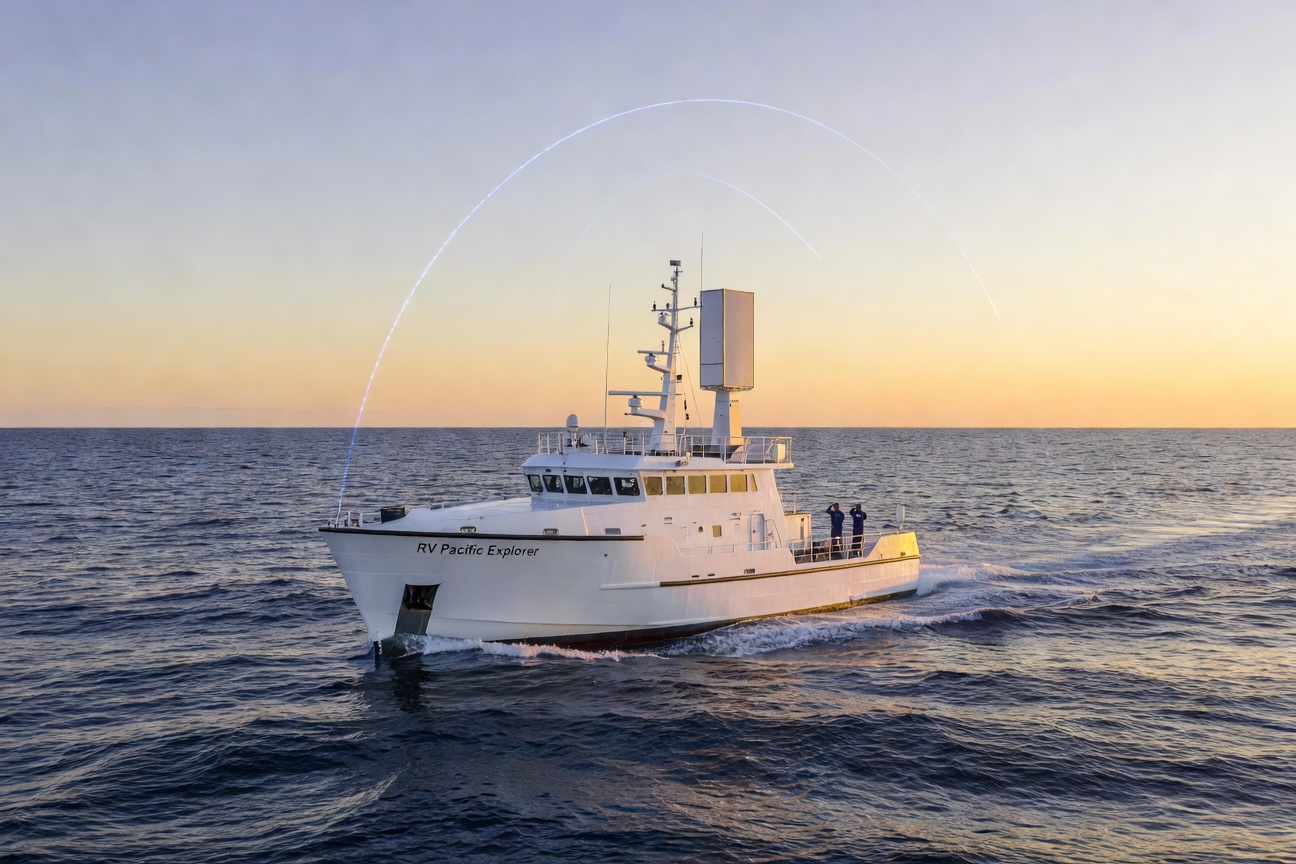
The alarm goes off at 4:52 AM, and before Dr. Yuna Sato even swings her legs over the edge of her bunk, she checks the dashboard. Not the weather dashboard, not the sonar log. The satellite connection dashboard. Because out here, 340 nautical miles southwest of the Hawaiian archipelago, in the absolute nowhere of the central Pacific, the difference between a productive research day and a frustrating exercise in data-hoarding depends entirely on whether the flat-panel Starlink terminal bolted to the RV Kairos's port mast spent the night doing its job.
It did. Download: 187 Mbps. Upload: 43 Mbps. Latency: 28 milliseconds. She exhales. Coffee can wait thirty seconds longer.
This is not a story about a satellite. It is a story about what becomes possible when a satellite is simply assumed to be there.
The Morning Sync That Used to Take a Week
By 5:15 AM, Sato has already done something that would have been logistically absurd aboard a research vessel five years ago. She has uploaded 11.4 gigabytes of acoustic telemetry data, collected overnight from the array of hydrophones trailing behind the Kairos, directly to a shared cloud environment where her collaborators at the University of Tokyo and the Monterey Bay Aquarium Research Institute are already awake and pulling files. One of them, a postdoctoral researcher named Fabian, has run a preliminary clustering algorithm on the first two hours of data and left a voice note in their shared workspace. Sato listens to it while watching the Pacific turn from black to bruised violet.
"The mid-frequency signature around 0300 UTC looks unusual," Fabian says, his voice slightly compressed but perfectly intelligible. "Could be a Cuvier's beaked whale, but the dive depth on the concurrent CTD cast doesn't match the profile. Want me to pull satellite SST composites for the patch and overlay?"
Sato types back: yes, and also run it against last month's tagging data. She presses send. The message departs through the Starlink terminal, hops to a low Earth orbit satellite cruising at roughly 550 kilometers above her head, gets routed through SpaceX's ground infrastructure, and arrives at Fabian's laptop in Yokohama before she has finished the sentence in her head. This is the new normal. It still occasionally stuns her.
The technology making this possible is SpaceX's Starlink Maritime service, which the company has aggressively expanded since its initial rollout, now covering virtually every ocean basin with its constellation exceeding 6,700 active satellites. The flat high-performance terminal on the Kairos costs roughly $2,500 upfront and $5,000 per month for the research-tier plan. For a federally funded science vessel, that is a rounding error compared to the cost of the ship itself. For the quality of science it enables, Sato says it is "practically free."
Mid-Morning: When the Ocean Talks Back in Real Time
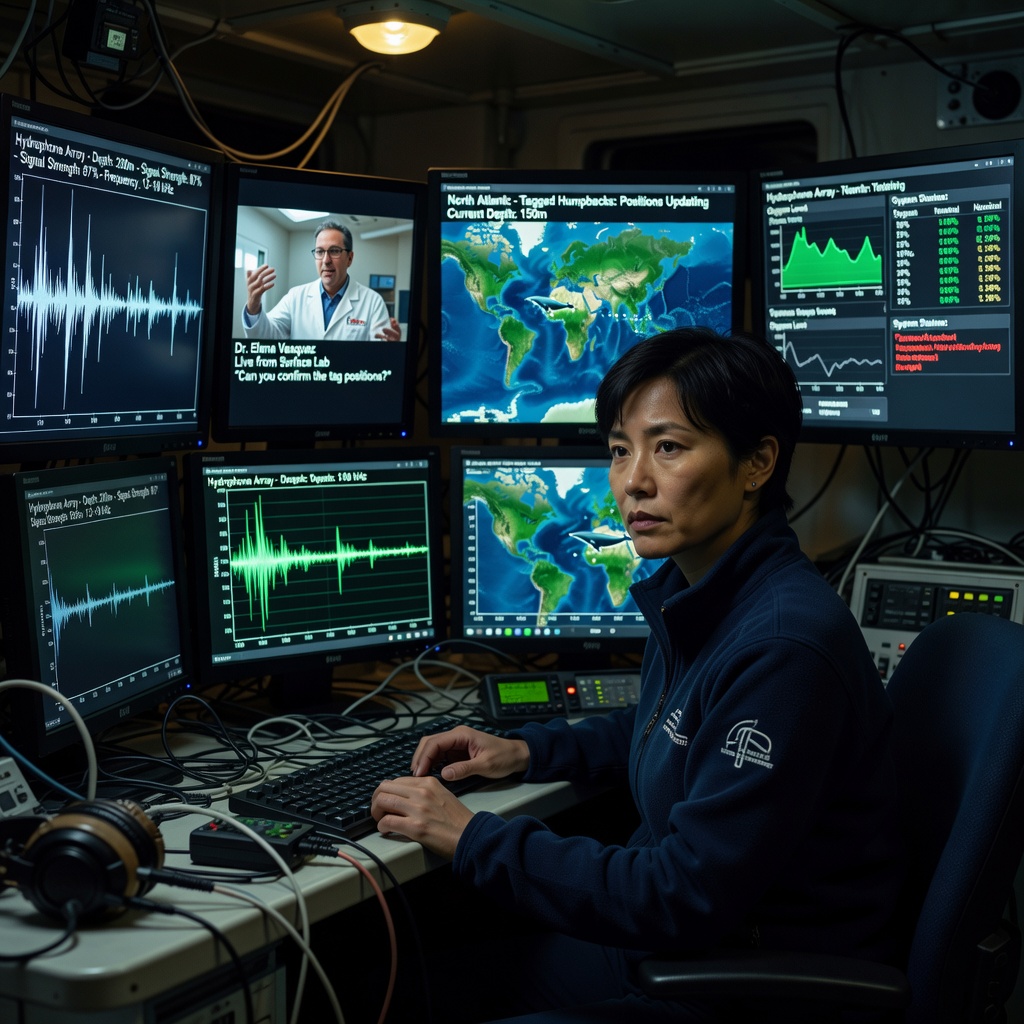
By 9:30 AM, the science is accelerating in ways that feel slightly dizzying. Sato is coordinating a trawl survey in the mixed-layer zone while simultaneously participating in a video call with a National Oceanic and Atmospheric Administration program officer in Silver Spring, Maryland, who is asking detailed questions about their cetacean-fisheries interaction data. On a second monitor, a live map updates every four minutes with positions from satellite-tagged albacore tuna, data streaming in from a completely separate constellation operated by Wildlife Computers and relayed through Argos, the French-American satellite telemetry system. On a third screen, automated image recognition software is flagging frames from the vessel's underwater camera array, tagging potential bycatch species for her review.
None of this is being stored for later analysis. It is all happening right now, while the ocean is being sampled. The analytical loop that once stretched across months, from field collection to lab processing to publication, has been compressed so aggressively that Sato sometimes catches herself adjusting the trawl station plan in real time based on patterns emerging from data collected an hour ago. This is adaptive sampling. It used to be a theoretical ideal discussed at conferences. Now it is just Tuesday.
The enabling layer, she emphasizes when asked, is not merely having internet access. It is having internet access with low enough latency to feel synchronous. The original generation of geostationary satellite internet, which researchers on vessels like this relied on for years, operated with round-trip latencies of 600 to 800 milliseconds. That is enough lag to make video calls stilted, collaborative tools sluggish, and real-time data pipelines unreliable. Low Earth orbit constellations like Starlink changed the fundamental physics of the problem. Shorter orbital altitude means shorter signal travel time, and 28-millisecond latency transforms remote fieldwork from a compromise into a genuine peer of land-based research.
The Competitors Circling the Same Sky
Starlink is not alone in this ocean, figuratively or literally. Amazon's Project Kuiper, which achieved its first major batch satellite deployment earlier this year and is targeting commercial service launch in the near term, is building toward a constellation of over 3,200 satellites with particular emphasis on enterprise and government customers. OneWeb, now operating as Eutelsat OneWeb after its merger with the French telecommunications giant, has been quietly carving out significant market share in the maritime and aviation sectors across Europe, Africa, and polar regions. Telesat's Lightspeed constellation, backed by Canadian government investment and targeting LEO broadband with a smaller but highly optimized satellite fleet, is positioning itself specifically for high-reliability enterprise use cases where uptime guarantees matter more than raw consumer volume.
For Sato, brand loyalty is a non-issue. She uses whatever system the vessel's chief engineer has optimized for a given deployment. On her last cruise in the Bering Sea, that was OneWeb, whose polar coverage geometry offered better elevation angles at high latitudes. In the Pacific tropics, Starlink's denser orbital shell provides more consistent throughput. The real story is not which constellation wins. It is that researchers, ship crews, and remote workers now think of satellite internet the way they think of GPS: a utility so reliable it has dissolved into the background of professional life.
Afternoon: A Consultation That Crosses Three Time Zones and One Ocean
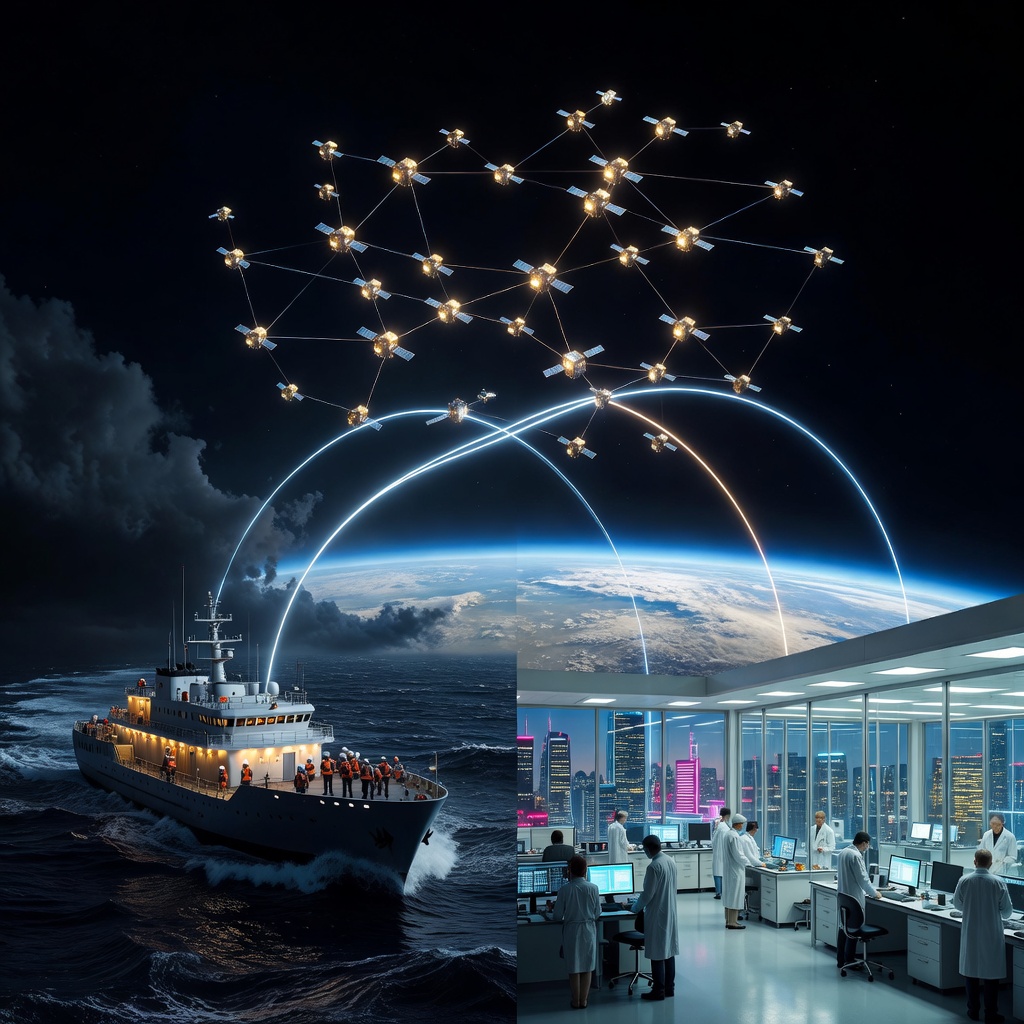
At 2:14 PM Pacific time, Sato joins what her calendar describes as a "quick check-in" that runs for ninety-three minutes. Participants include a fisheries economist in Wellington, New Zealand; a climate modeler at the Max Planck Institute in Hamburg; a data engineer from a San Francisco startup building AI-assisted species distribution models; and a graduate student in Cape Town whose thesis is partially built on the tagging data streaming from the Kairos right now, in real time, as they talk.
The Cape Town student, Amara, pulls up a visualization during the call that incorporates this morning's acoustic detections alongside satellite sea surface temperature data and three years of historical trawl records. She found a pattern that suggests the tuna aggregation Sato is currently sampling may shift northeast within 48 to 72 hours as a thermal front migrates. She built this model while the Kairos was actively collecting the data that fed it. The call ends with Sato adjusting tomorrow's station plan accordingly.
This is what the satellite internet industry rarely advertises but arguably should: the compounding scientific value of connectivity. A single research cruise generates data. A research cruise connected in real time to a global analytical community generates knowledge.
Sunset and the Silence That Isn't Silent Anymore
By 7 PM, the formal science day is winding down. The trawl gear is secured. The overnight hydrophone array is deployed. Sato stands on the aft deck with a bowl of rice and watches the sun fold itself below the horizon in that particular Pacific way, unhurried and enormous. The terminal on the mast is still transmitting. It will transmit all night. Somewhere above her, dozens of Starlink satellites are passing in succession, each one handing off the connection to the next in a choreography of orbital mechanics so precise it is invisible to the user below.
She thinks about what her PhD advisor used to say about fieldwork: that the best insights come from the enforced isolation of remote science, from being cut off enough to think clearly. She is not sure she agrees anymore. The insights from today did not come from isolation. They came from the collision of her observations with Fabian's algorithms, Amara's models, and the institutional memory of everyone on that afternoon call. The ocean provided the data. The constellation provided the conversation.
Tomorrow, weather permitting, she will be 40 nautical miles further southwest. The satellite will follow her there, as it always does now, as reliably as the sun.
The next generation of marine researchers will find this unremarkable. That might be the most significant sentence in this entire story.
"We used to talk about bandwidth like it was a luxury at sea. Now I talk about it the way I talk about the engine. It is not a feature. It is a precondition."