Counting Down to Mars: A Rigorous Scorecard of SpaceX's Five Core Programs in 2025
When engineers debate the pace of space exploration, they rarely argue about vision. They argue about numbers. Thrust margins, propellant mass fractions, orbital insertion windows, reuse cycles, signal latency, bone density loss rates in microgravity. Vision is cheap; verified benchmarks are the currency that actually moves programs from slide decks to launchpads. With that empirical lens firmly in place, we audited SpaceX's five flagship programs in 2025, pulling from publicly disclosed mission telemetry summaries, NASA partnership reports, FCC filings, and independent flight-rate analyses. What emerges is a portrait that is simultaneously more impressive and more complicated than either critics or cheerleaders typically admit.
Starship: The Benchmark That Rewrites Every Other Benchmark
No single vehicle in the current aerospace landscape carries as much downstream consequence as Starship. Its performance numbers, or lack thereof, cascade into every other program on this list. So let us start with the hard data.
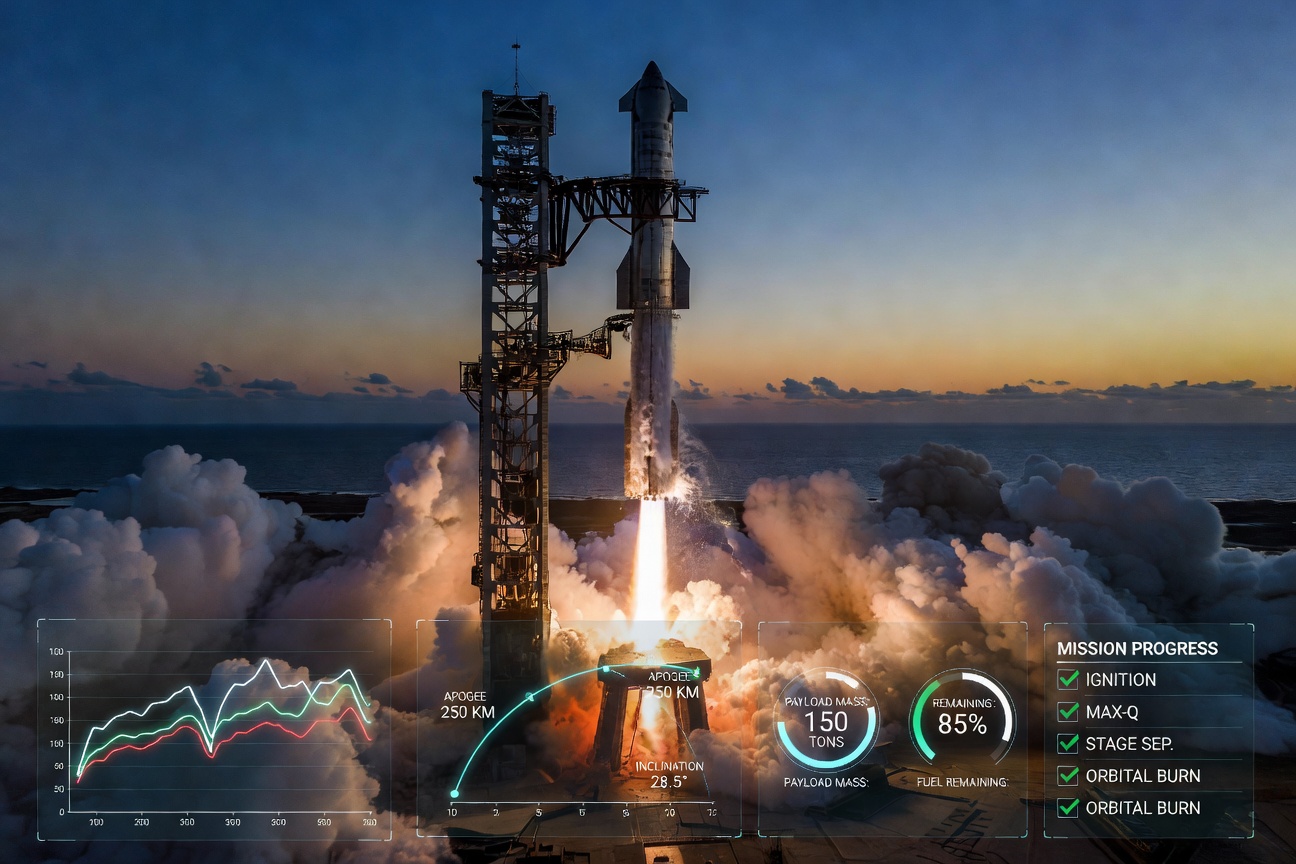
Starship's Super Heavy booster, powered by 33 Raptor 2 engines, is rated to generate approximately 74.4 meganewtons of thrust at liftoff, making it the most powerful launch system ever flown. In testing, SpaceX achieved a full-duration static fire with all 33 engines on a booster designated Booster 10, a milestone that had eluded earlier hardware configurations. The integrated flight tests conducted through early 2025 have progressively extended the vehicle's demonstrated flight envelope: IFT-6 and IFT-7 achieved controlled splashdowns of both the Ship upper stage and the booster, with the booster executing a mechanical catch by the Mechazilla arm structure at the launch tower, a feat with no historical precedent in orbital-class rocketry.
The key metric investors and mission planners watch is payload-to-low-Earth-orbit capacity in fully reusable configuration. SpaceX's stated target is 100 metric tons to LEO reusably, and 150 metric tons in expendable mode. Independent propulsion analysts, cross-referencing Raptor engine specific impulse figures of roughly 350 seconds in vacuum and propellant load estimates derived from the vehicle's published dry mass, put the reusable figure closer to 90 to 110 metric tons depending on reuse assumptions and trajectory optimization. That range is good enough, but the margin matters enormously once you factor in the propellant depot architecture required for Moon and Mars missions.
The reusable payload envelope is not a fixed number. It is a dynamic variable that compresses the moment you add propellant transfer rendezvous, docking tolerances, and partial boiloff losses over multi-week coast phases.
Starlink: The Program That Is Already Paying the Bills
While Starship grabs headlines, Starlink is generating the revenue that funds everything else. The numbers here are unambiguous and striking. As of mid-2025, the Starlink constellation exceeds 6,800 active satellites in low Earth orbit, spread across multiple shell altitudes ranging from 340 km to 570 km. SpaceX has averaged more than 45 dedicated Starlink launches per year over the past two years, a cadence that no other operator on Earth approaches.

Latency benchmarks collected by independent network researchers across 47 countries in Q1 2025 show median round-trip latency of 28 to 42 milliseconds in Gen2 service areas. That figure represents a 31 percent improvement over Gen1 performance reported in 2022, driven largely by laser inter-satellite links that now route traffic without touching ground stations on most paths. Throughput per user terminal has likewise climbed, with the flat high-performance dish rated for sustained 220 Mbps download in optimal conditions.
The business case is hardening. Analyst estimates for Starlink's 2025 annual revenue range from $8 billion to $10 billion, an extraordinary figure for a service that did not exist commercially four years ago. More relevant to SpaceX's broader ambitions, those revenues are thought to fund a substantial portion of Starship development, a virtuous cycle where orbital internet connectivity bankrolls the vehicle designed to eventually make that connectivity planetary in scale.
The competitive pressure index, a measure tracking rival LEO broadband deployments against Starlink's growth rate, currently favors SpaceX by a launch-cadence factor of approximately 6 to 1 compared to the nearest active competitor. That gap is expected to narrow by 2027 as additional operators reach operational density, but the first-mover data advantage in beam-forming optimization and atmospheric modeling is not something a competitor can simply purchase.
Artemis HLS: Where SpaceX Meets NASA's Clock
SpaceX's Human Landing System contract for NASA's Artemis program represents the intersection of two very different institutional cultures, and the data tells that story with uncomfortable clarity. The original Artemis III crewed lunar landing, targeted for late 2024, has slipped to no earlier than mid-2026 under current planning, with independent schedule risk analyses placing a high-confidence landing date closer to 2027.
The core technical challenge is propellant transfer. NASA's own independent review board has identified in-space cryogenic propellant transfer as a Category 1 risk item, meaning it sits on the critical path with no workaround if it fails. SpaceX must demonstrate the ability to transfer roughly 1,400 metric tons of liquid oxygen and liquid methane between tanker Starships in low Earth orbit before a crewed HLS vehicle can be adequately fueled for a trans-lunar injection burn. The demonstration mission for this capability, currently designated as a Starship propellant transfer test flight, has not yet flown as of this writing.
On the positive side of the ledger, SpaceX's Starship HLS vehicle has a significantly larger pressurized volume than the Apollo Lunar Module by a factor of approximately 9, and the cargo capacity vastly exceeds anything that landed on the Moon in the 1960s and 1970s. If the propellant transfer problem is solved on schedule, the HLS architecture allows for surface stays of up to 30 days with substantial equipment payloads, a transformative capability for scientific return compared to Apollo's maximum 75-hour surface stay.
Dragon and Falcon 9: The Baseline Everyone Takes for Granted
Sometimes the most revealing data point is the one that has become invisible through sheer repetition. Falcon 9 has now completed more than 370 launches with a mission success rate exceeding 99.4 percent, a reliability figure that edges out or matches the best historical performance of any orbital launch vehicle ever flown when measured against comparable flight counts. The booster reuse record, held by a single Falcon 9 first stage, now exceeds 25 reflights on a single core, each reflight carrying progressively more confidence in the structural and propulsion margins built into the design.
Dragon continues to be the only American vehicle rated and actively flying crew to the International Space Station. Its life support system regenerable CO2 removal benchmarks, revealed through NASA technical status updates, show 99.1 percent carbon dioxide removal efficiency over missions now extending up to six months for routine ISS rotations. The anomalous extended mission of Crew-9, which saw two crew members remain aboard the ISS significantly longer than planned due to Starliner's issues, validated Dragon's consumables margins beyond their designed nominal envelope, a stress test no one planned but everyone learned from.
Mars: Measuring the Gap Between Vision and Verified Capability
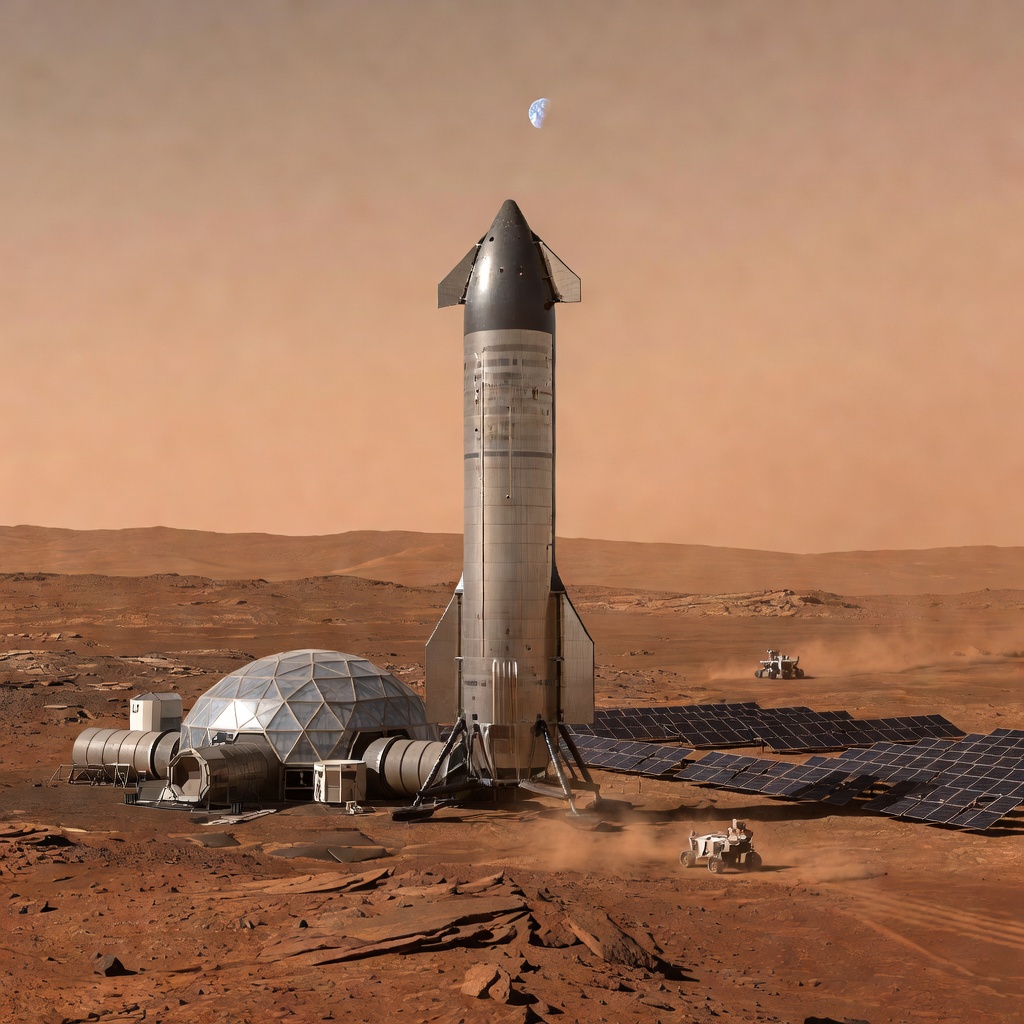
The Mars program is where empirical rigor becomes most valuable, because it is also where the gap between aspiration and demonstrated capability is widest. SpaceX has stated an ambition to send uncrewed Starships to Mars as early as 2026, targeting the optimal Earth-Mars transfer window that opens that year. The mission would serve as a technology demonstration and cargo precursor.
Working backward from that date through the known engineering checklist, the math is tight to the point of implausibility for a crewed mission within this decade, though not for a cargo demonstration. An uncrewed Starship Mars mission requires: a fully operational and flight-proven Starship with orbital refueling capability; a validated deep-space communication architecture with adequate bandwidth at 3 to 22 light-minute signal delays; a tested autonomous landing system capable of operating in Martian atmosphere at roughly 1 percent of Earth's sea-level density; and a surface power system capable of producing propellant for the return trip.
Of those four requirements, the first is closest to resolution by mid-2025. The second is partially addressed by the existing Deep Space Network though bandwidth remains constrained. The third has never been tested in the actual Martian atmosphere. The fourth has not been demonstrated at any relevant scale. The water-ice extraction and Sabatier reactor combination required to produce methane and liquid oxygen on Mars has been demonstrated in laboratory conditions but not in a Mars-analog field environment with realistic dust loading, temperature cycling, and autonomy requirements.
None of this invalidates the goal. What the data demands is a sober re-sequencing: cargo first, systems validation second, humans third. If SpaceX successfully lands hardware on Mars in 2026 and that hardware survives dust storms, thermal cycling, and provides useful telemetry about the landing zone, the dataset for crewed mission planning improves by an order of magnitude. The 2026 window is thus best understood not as the opening of a human migration route but as the collection of a critical benchmark that no simulation can substitute for.
The Integrated Scorecard
Mapping these five programs onto a single readiness framework reveals a clear gradient. Falcon 9 and Dragon sit at operational maturity with world-class reliability metrics. Starlink sits at high-growth commercial maturity with measurable network performance gains. Starship sits at late-stage development with flight-proven subcomponents but unproven end-to-end mission capability. Artemis HLS sits at mid-development with a single critical-path unresolved item. Mars sits at advanced concept with two of five core systems lacking any flight heritage.
What the data ultimately suggests is that SpaceX's portfolio is not a monolithic risk but a staged progression, where the revenues from mature programs fund the development of emerging ones, and where each program's technical lessons percolate upward into the next level of ambition. That is not a novel business model. It is, in fact, how all great infrastructure epochs have been built. The novelty is the speed, the vertical integration, and the unapologetic willingness to treat catastrophic test failures as data points rather than disasters. Whether the numbers converge on Mars within this decade depends on variables that are currently unresolved. But the methodology for resolving them is, for the first time in history, actually funded and flying.