The Bone Problem: How SpaceX's Constellation of Missions Is Racing to Solve the Hidden Biology of Deep Space

Picture a researcher at NASA's Johnson Space Center, late on a Tuesday in 2026, staring at a dual-energy X-ray absorptiometry scan pinned to a light board. The image belongs to a test subject who spent eight months aboard a Starship-derived orbital habitat prototype, part of a joint SpaceX-NASA biomedical trial quietly running in parallel to the more photogenic rocket launches. The scan tells a brutal story: trabecular bone density in the subject's lumbar spine has dropped by nearly 14 percent. The researcher sets down her coffee and types a single word into her lab notebook: "Unacceptable." That word, in a sense, is the invisible engine driving every program SpaceX currently operates. Because rockets are the easy part.
The conversation around SpaceX in 2025 and beyond is dominated by hardware: the towering silhouette of Starship on Pad A at Boca Chica, the relentless cadence of Falcon 9 launches threading Starlink satellites into low Earth orbit like beads on an invisible string, and the ceremonial weight of Artemis commitments that bind SpaceX to NASA's lunar ambitions. But beneath all of that gleaming metal and controlled fire, a quieter revolution is being forced into existence. SpaceX's programs are not merely solving engineering problems. Collectively, they are building a life-support system for the human species at interplanetary scale, and the most stubborn obstacles are not aerodynamic or thermodynamic. They are biological.
Starship's Evolving Role: From Launch Vehicle to Interplanetary Life Pod
Starship completed its most demanding integrated flight tests in 2024 and early 2025, with SpaceX recovering both the Super Heavy booster and the Starship upper stage using the now-iconic "mechazilla" mechanical arm catch system at the Starbase facility. Each successive flight has layered new capabilities: extended propellant transfer demonstrations, refined heat shield tile performance in the brutal reentry corridor, and increasingly autonomous landing sequences. But the engineering community's attention is shifting from whether Starship can reach orbit to what kind of environment it creates for the humans eventually riding inside it.
SpaceX engineers working on Starship's pressurized cabin architecture are grappling with a constraint that no amount of Raptor engine thrust can overcome: a transit to Mars under current trajectories takes between six and nine months, during which passengers will float in microgravity, absorb radiation doses well beyond International Space Station norms, and exist inside a sealed volume roughly equivalent to a studio apartment. The bone density loss observed in long-duration ISS crews, averaging around one to two percent per month in load-bearing regions, becomes an acute threat over a Martian transit. SpaceX has not publicly detailed its countermeasures, but filings, partnership announcements, and supply chain signals point toward an artificial gravity research agenda embedded within the broader Starship development roadmap.
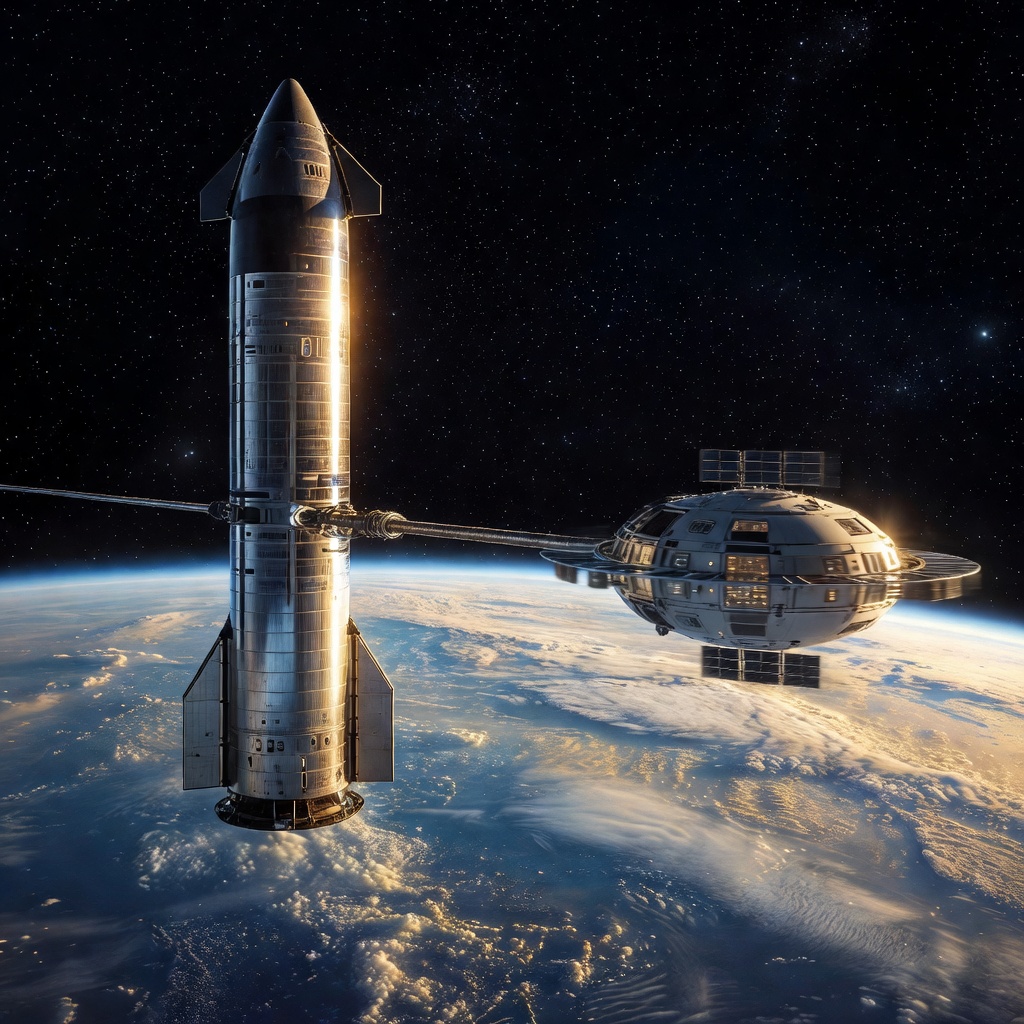
One possibility gaining traction in academic literature linked to SpaceX contractors involves a tethered rotation scheme: two spacecraft or modules connected by a cable and spinning around a common center point to generate centripetal acceleration. At a tether length of roughly 450 meters and a rotation rate of about two revolutions per minute, passengers at the far end would experience approximately one-third Martian gravity, enough to meaningfully slow bone and muscle degradation without inducing severe Coriolis disorientation. Whether Starship's architecture can accommodate this remains an open engineering question, but the trajectory of the program suggests the answer will not remain hypothetical for long.
Starlink: The Cash Engine and the Unexpected Science Platform
SpaceX's Starlink constellation has crossed the threshold of six thousand active satellites in low Earth orbit and continues to expand with each Falcon 9 rideshare mission. The commercial revenue Starlink generates, now measured in billions of dollars annually, is the financial substrate upon which every other SpaceX ambition rests. Without Starlink's subscriber base providing a cash cushion, the capital-intensive development of Starship, the lunar lander contracts, and the long-horizon Mars program would face existential budget pressure. In this sense, every time a fishing vessel in the North Atlantic or a rural clinic in sub-Saharan Africa connects to Starlink, it is inadvertently purchasing a brick in the foundation of interplanetary civilization.
What is less discussed is Starlink's emerging role as a distributed scientific instrument. The constellation's sheer density and precise orbital mechanics make it an extraordinary tool for atmospheric science, ionospheric monitoring, and geodesy. Researchers have begun using Starlink signal propagation data to detect ionospheric disturbances caused by seismic activity, volcanic eruptions, and solar weather events with a resolution that legacy ground-based networks cannot match. For a company whose stated mission involves making humanity multiplanetary, the ability to monitor and model Earth's space environment in near real time is not an academic luxury. Understanding how solar energetic particle events distort Earth's ionosphere is directly relevant to predicting radiation exposure windows for crews aboard Starship during transit phases outside Earth's magnetospheric protection.
Artemis and the Lunar Gateway: SpaceX Enters the Institutional Arena
SpaceX's Human Landing System contract with NASA for the Artemis program places the company at the center of humanity's first crewed lunar return since Apollo 17 in 1972. The Starship HLS variant, adapted for lunar surface operations with extended landing legs, a dedicated crew elevator, and surface-optimized propulsion, represents a design divergence significant enough that it functions almost as a separate vehicle program running in parallel to the point-to-point and orbital variants of Starship.
Artemis III, currently targeting a lunar south pole landing in the mid-2020s, will be the debut of SpaceX's HLS in the highest-stakes operational environment imaginable. The lunar south pole is scientifically extraordinary: permanently shadowed craters harboring water ice deposits that could supply both drinking water and hydrogen-oxygen propellant for future missions. But it is also topographically treacherous, with slopes, boulders, and lighting conditions that challenge even the most sophisticated autonomous landing algorithms. SpaceX's approach leans heavily on its accumulated precision landing data from hundreds of Falcon 9 booster recoveries and Starship test flights, feeding those datasets into the navigation systems of HLS to build confidence in soft, accurate touchdown on unprepared terrain.
"The Moon is not the destination. It is the proving ground. Every system we validate at the lunar south pole is a system we are trusting with human lives on the Martian surface four years later."
Mars Colonization: The Timeline Compression Nobody Is Talking About
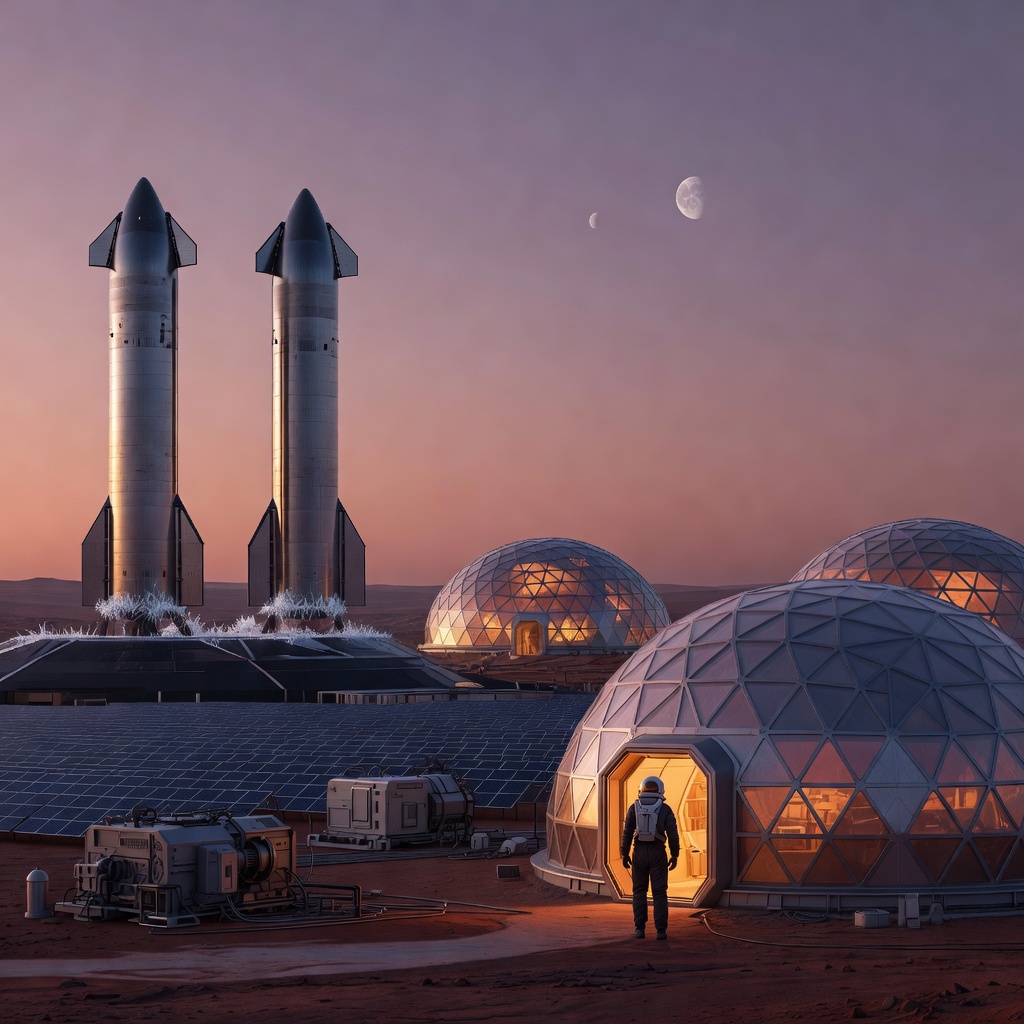
Elon Musk has publicly described a Mars colonization timeline involving initial uncrewed cargo landings using Starship in the 2026 synodic window, the roughly 26-month orbital alignment that brings Earth and Mars into favorable proximity. If those missions succeed in demonstrating propellant production from Martian atmospheric carbon dioxide and subsurface water ice, via the Sabatier process and electrolysis, crewed missions could follow in the 2028 or 2029 window. This compression of timelines, from theoretical to operational in under a decade, is either the most audacious engineering program in human history or a masterclass in aspirational scheduling pressure used to accelerate team performance. Possibly both.
What the timeline discussion consistently underweights is the regulatory and biological certification burden. The FAA's expanded oversight of Starship launch operations, formalized through a multi-year licensing framework being developed at Boca Chica and the Kennedy Space Center launch complex, means that human-rated Starship flights face a certification process with no historical precedent in pace or complexity. NASA's human-rating standards, while not directly applicable to purely commercial Mars missions, set a de facto benchmark that SpaceX's own safety culture would demand meeting. Achieving human-rated status for a vehicle that has been iterating visibly and publicly, in the tradition of Musk's "fail fast" ethos, requires a cultural and procedural pivot that is as challenging as any aerodynamic problem.
The Convergence Point: When Biology, Physics, and Commerce Collide
Step back from any single SpaceX program and a coherent strategic topology emerges. Starlink funds the operation and, incidentally, builds planetary-scale sensing infrastructure. Falcon 9 and Falcon Heavy maintain commercial launch dominance and operational tempo, keeping the team's landing and reuse muscles sharp. Starship absorbs the lessons of every prior vehicle and scales them to a vehicle class capable of true interplanetary cargo and crew transport. Artemis validates human lunar operations and builds institutional relationships that smooth the regulatory path for independent Mars missions. And threading through all of it, sometimes visibly and sometimes in the background of biomedical subcontracts and academic partnerships, is the bone problem. The muscle problem. The radiation problem. The psychological isolation problem.
None of these biological challenges will be solved by a single breakthrough. They will be solved the same way SpaceX solves aerodynamic problems: iteratively, empirically, with hardware in the field and data feeding back into the next design revision. The difference is that the hardware in this case is human. The test subjects are volunteers strapping themselves into a vehicle pointed at a planet 225 million kilometers away, trusting that the data from eight months aboard an orbital habitat prototype, and the researcher who wrote "unacceptable" in her lab notebook and then got back to work, was enough to bring them home intact.
That trust, ultimately, is what every Starship flight, every Starlink satellite, and every lunar touchdown is slowly earning. Not from regulators or investors, but from the future crews who will one day read the test data and decide that the numbers are good enough to climb aboard. SpaceX's most important launch has nothing to do with thrust or trajectory. It is the moment a human being looks at the biology data and says: we are ready.